
May the Forces be With You – Lesson Overview
Foundation Lessons
These lessons form the core of the May the Forces be With You module, and it is recommended that teachers complete at least the first 7 lessons. You can read through the overviews below or you may wish to check through the activity demonstration videos linked on the right to get a quick idea of the concepts and methods involved in this module.
MF 1.1 – Tug of War The Maths of Arrows
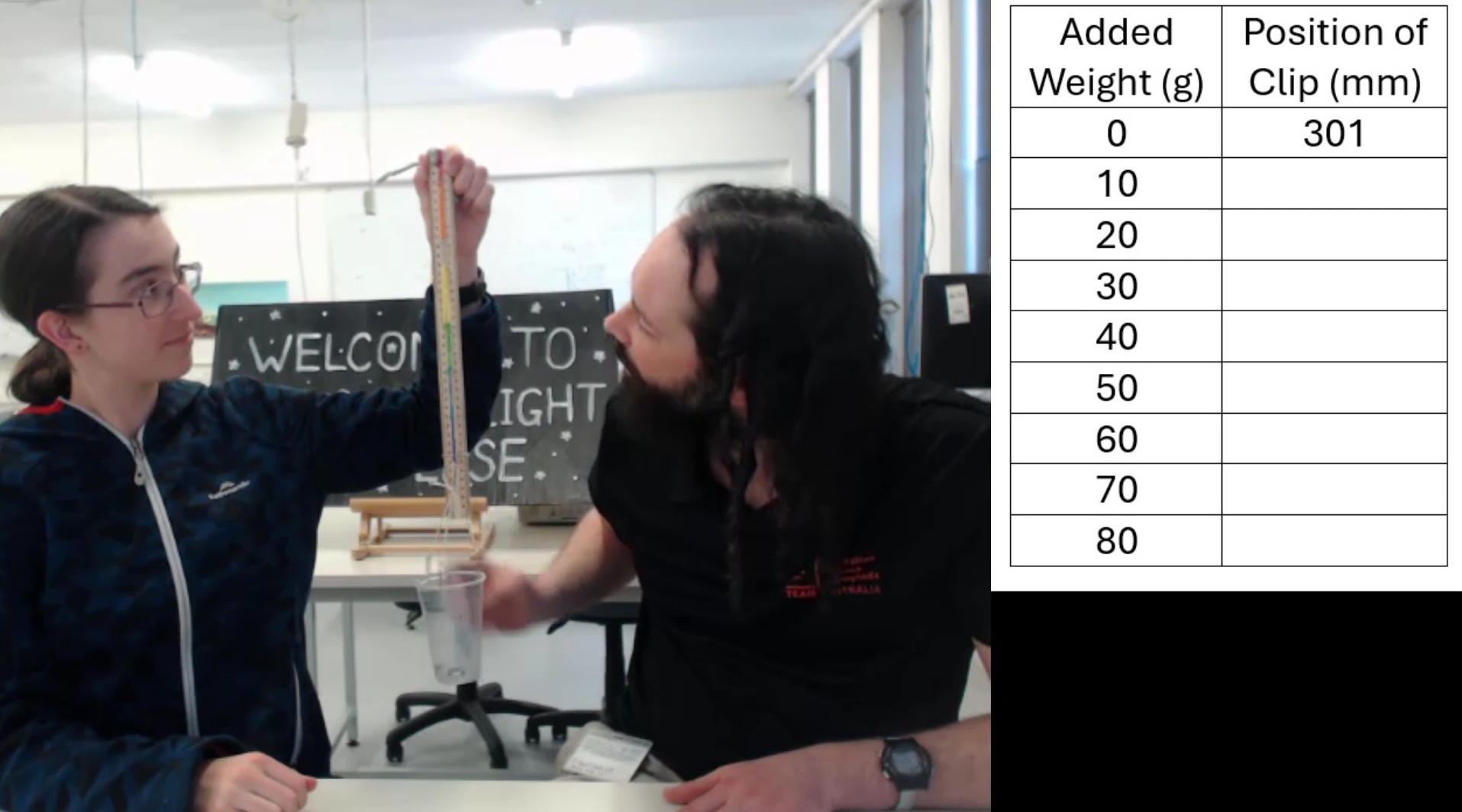

MF 2.2 Block Launcher
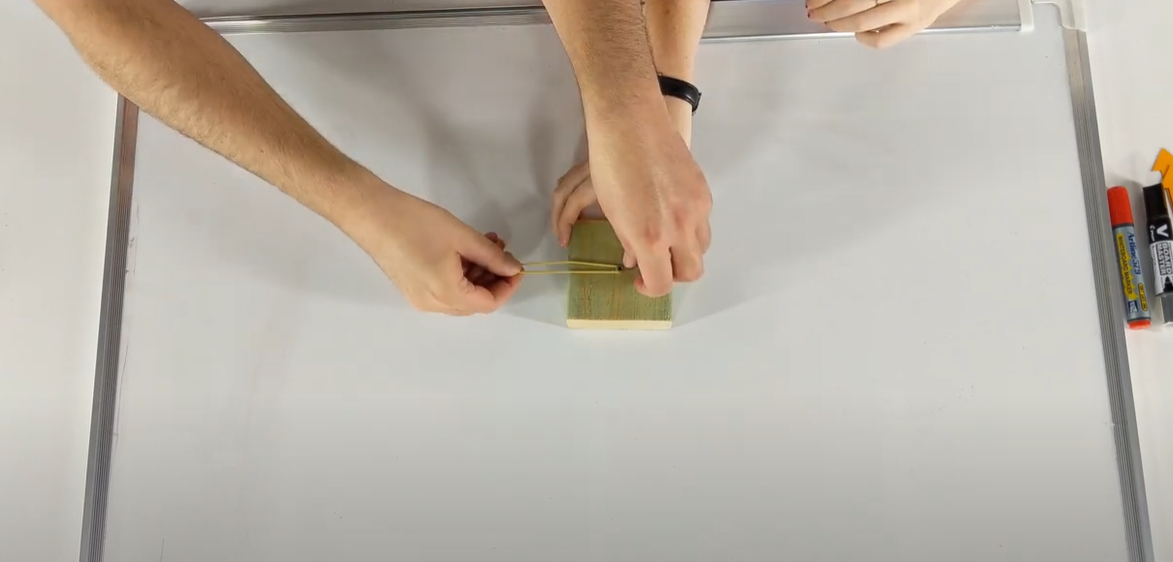
MF 3.1 Rubber Band Forces
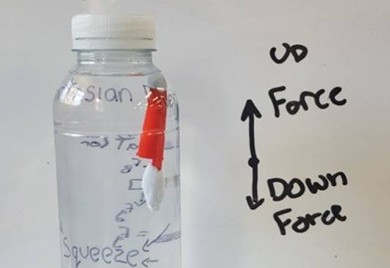
MF 3.2 – Cartesian Diver
MF 4.2 – Time Warp
MF 6.1 – Exploring Electric Forces
MF 7.1 – Exploring Magnets
MF 7.2 – Seeing Magnetic Fields
MF 8.1 – Electromagnetic Forces
Please see the Getting Started page for information regarding pretests and how to introduce the May the Forces be With You module.
Students develop the concepts of force and associated quantities through thinking about pushing a car and a tug-of-war activity in small groups. These are used to introduce using arrows to represent forces. Then students do activities throwing and catching different mass balls. Throughout we introduce the language of forces and concepts of mass, distance, time, speed, momentum, acceleration, inertia, and friction.
Introduction: Forces and Arrows One of the most important ideas in the modern world is forces because they make things move. Another important idea is using arrows to represent things. We use arrows in this lesson to represent the strength and direction of student-created forces.
Forces and motion: Because forces make things move, this lesson introduces the language of motion: force, distance, mass, speed, acceleration, deceleration, and momentum (combination of speed and mass). We use a Word Wall for these words.
Pushing a car: Teacher-led discussion/optional activity The lesson begins by asking students to visualise pushing a car in the teacher’s car park (we encourage pushing a car if this is permitted). We use this to introduce the language of motion, and we use arrows to represent students' individual forces and then to combine them all together. Magnetic arrows, one for each student, lets them add their arrows head to tail on the whiteboard and understand the combined arrow as a large force.
Tug-of-war Activity: Small group (5 or 4 students) activity about adding and cancelling forces in a tug-of-war tournament. Students pull against each other in one-on-one tugs, represent the near-cancelling forces with arrows and determine their rank order (see worksheet). Finally they do a 2-on-3 competition to see if the three weakest can beat the two strongest.
Sports activity: throwing, catching and feeling the momentum of heavy and light balls: Small groups work with ping-pong balls and basketballs to reinforce the concepts introduced above by doing simple throwing and catching activities plus a “feeling momentum” activity.
Extension activities in sport: Reinforce student learning by using the newly learned vocabulary in other sport activities.
Review and introduce the next lesson: Identify and review all new words and start the class Word Wall.
Students use rubber bands looped together to make a force measurer using a short length of wood, string, plastic cup and ‘standard’ weights (e.g. 20 grams). They then use it to weigh different objects. Finally, they explore how different forces affect how far an object moves.
1.) Introduction: review the words used in the previous lesson and complete and mark the jumbled word quiz.
2.) Discussion: Explain that we will make a simple force measurer, but before doing that we need to be introduced to the unit used to measure force, the newton. Students need to be reminded about using units in science or mathematics when measuring things, referring to units used to measure distance, mass or weight and time.
3.) Optional Activity: The students now work in groups to:
a) make a simple force measurer from a piece of timber, elastic band, paper clip, string, heavy nuts or other known masses, and plastic cup by:
- following the set of instructions
- using ‘standard’ masses such as heavy 20- or 50-gram masses to add the scale (or calibrate) the force measurer in newtons
b) use their force measurer to measure the gravitational force on several objects.
4.) Investigation: Students then work in their groups to design and conduct an investigation using their force measurer and a block launcher to explore how blocks of different mass move if they are pushed with the same force. Students should relate this back to their ‘imagine’ experiment from the first lesson where students imagined they pushed the teacher’s car and also a loaded brick truck.
5.) Review and introduce the next lesson
Identify and review all new words and start the class Word Wall and let students know that in the next lesson we will briefly explain how forces can combine following the maths of arrows.
Students investigate two-way, three-way and four-way pull forces with rubber bands. Using a wooden block and rubber bands, they use arrows to show the forces’ directions and learn how to add and cancel these forces through the activity with the block. They then make a ‘Cartesian Diver’ and apply their knowledge of forces to a floating object.
Introduction: Explain that today we will be looking at forces and find out how to add two or more forces together. Before doing this remind students of key ideas about the nature and measurement of forces from lessons 1 and 2 particularly that forces have both a size and a direction.
Discussion: When we apply a force to an object, we can cause it to accelerate and move. If we add another force, we can make the object be still, move it in a different direction or even move it faster. It all depends on the direction of the new force. Show how arrows help us work out what direction an object might move and introduce the rule for adding arrows: Put arrows head to tail. The arrow needed to fill the gap between the start of the first arrow and the tip of the last arrow is the sum of all the forces.
Activity 1: Rubber band Forces: Students then work in their groups using wooden blocks and rubber bands to look at different forces and their directions, recording each trial on a piece of butcher's paper or whiteboard. There is a detailed set of instructions that give students the opportunity to explore single forces, two forces acting in the same direction and two forces acting in opposite directions.
Optional Extension Activity: Adding forces in two dimensions: There is an option to extend this to forces in two dimensions.
Activity 2: Cartesian Diver: In this activity students make a Cartesian diver and then explore the forces on it as the pressure in the water causes the weight of the diver to change.
Review and introduce the next lesson: Identify and review all new words and add these to the class Word Wall and explain that in the next three lessons we will briefly introduce you to electrical forces.
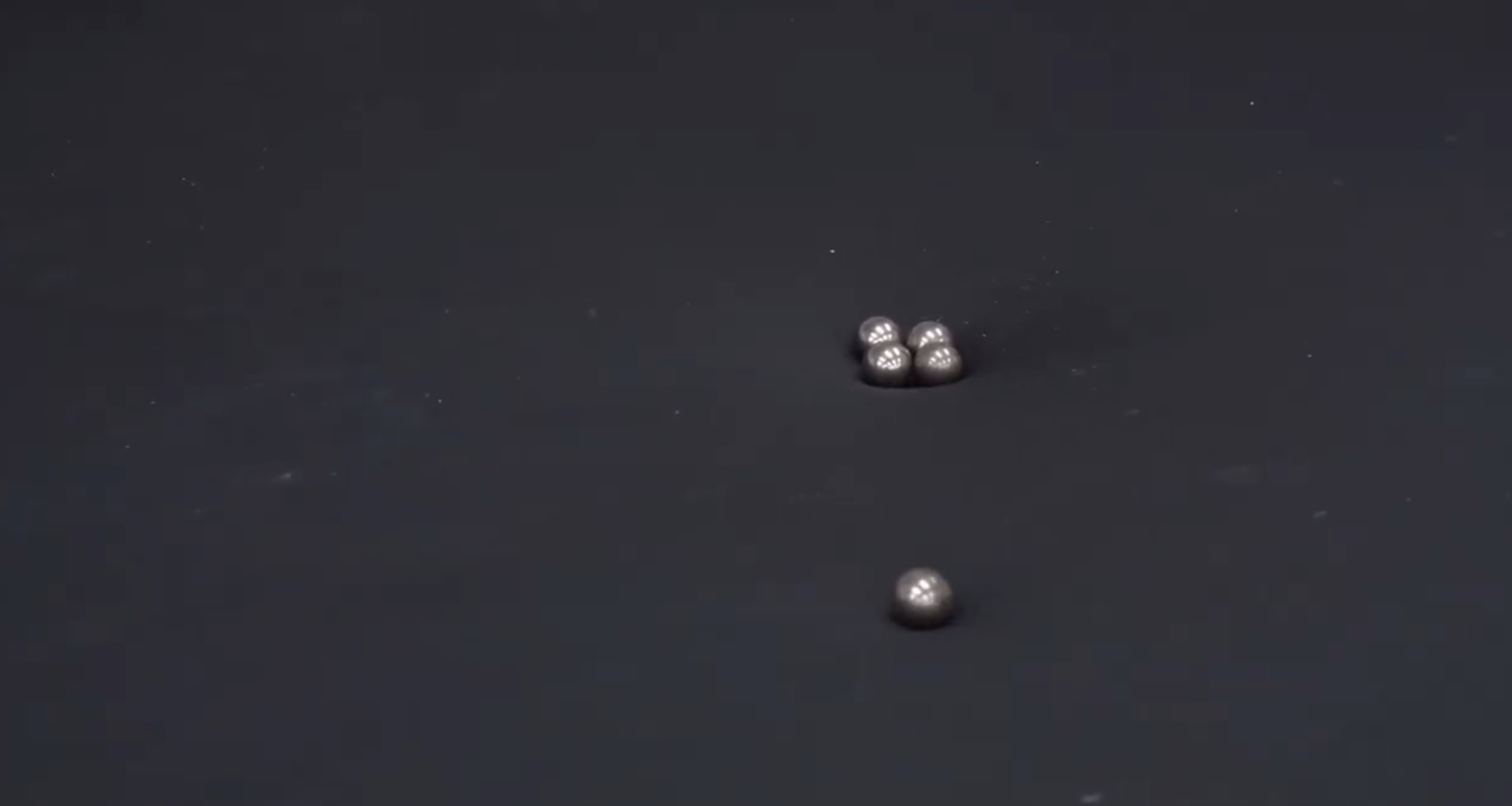
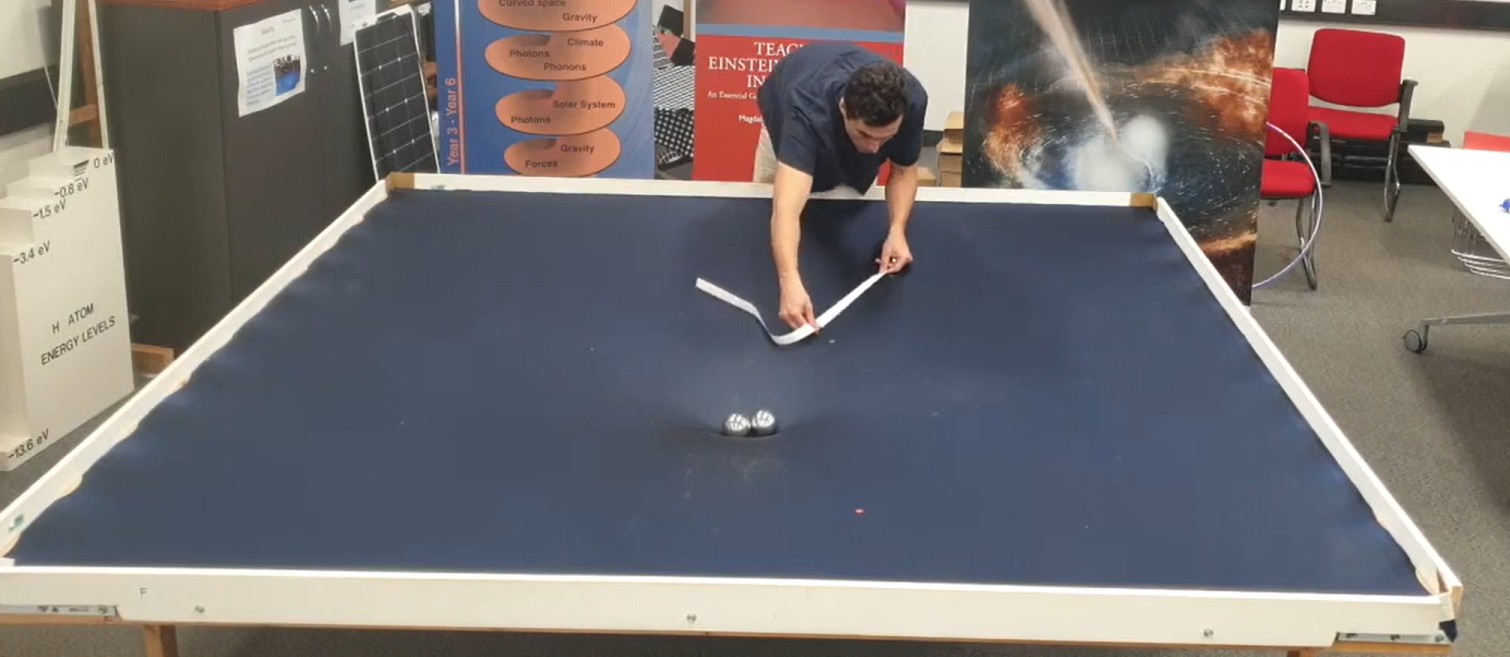
Students use the spacetime simulator to be introduced to Einstein’s theory of gravity. By adding masses to the spacetime simulator, they will see how mass curves spacetime. By drawing equally-spaced dots on a stretchy fabric, they observe how the distance between two dots changes when masses are added and recognise that the stretching of the fabric represents the stretching of space and time.
Introduction: Using the YouTube video: Newsweek Why Do We Age Slower In Space? Introduce the idea that time varies at different rates for people in different places.
Role-play to introduce the idea that time is relative: With the guidance of the teacher, class members are actors or audience for the brief play Welcome to the Slow Light Universe.
Spacetime Simulator Activities:
- Matter warps spacetime: Students place a few small masses randomly on the spacetime simulator and observe what happens.
- Matter attracts other matter in spacetime: Ask students to work in their groups and gather around the spacetime simulator. Invite one student to place a ball on the spacetime simulator and another to add one more ball about 30 cm away from the first. Observe what occurs. Several pairs can do this. Students then return to their group and discuss why the balls move towards one another. Write their answer on a piece of paper, ask the reporter from each group to read their answer.
- Creating orbits in spacetime: Students then learn how to make circular orbits on the spacetime simulator and practice creating orbits with large and small marbles/ball bearings and of different diameters.
- Musical Jingle: The teacher should display the jingle: ‘Matter tells spacetime how to curve; Spacetime tells matter how to move.’ on their screen and students should say the jingle together.
Teacher-led discussion: Highlighting the key ideas from the lesson
Reinforce key ideas learnt from the play and spacetime simulator activities: that time depends on the strength of gravity; that matter tells spacetime how to bend; that spacetime tells mass or matter how to move; and that gravity is the bending of spacetime.
Review and introduce the next lesson: Identify and review all new words and complete the class Word Wall and explain that during next week’s lesson students will explore gravity again, this time using a marble run and trampoline.
Students use the spacetime simulator to further explore the idea that gravity is curved spacetime that we observe as the force that stops things from freely falling.
Introduction: In lesson 4 we learnt that Albert Einstein introduced us to the new idea that gravity is curved spacetime. We saw this when we used our spacetime simulator to show that gravity is curved spacetime. We also learnt that matter tells spacetime how to curve and spacetime tells matter how to move.
Activity: Who can hold their arms outstretched the longest? Ask students to stand with their arms outstretched in front of them. Who can hold this position the longest? They then drop a ball or other small object and in groups discuss observations.
Activity: Observing the toy car fall towards the Earth: Working in groups of 4 to 6, students let the car roll from the outside of the lycra sheet toward the central mass. Discuss what you saw with your group. If students have a tablet or other digital device, ask them to video the toy car’s motion. If it is an option, video using the SloMo video function. Analyse the video of the car’s path from the outside edge to the central mass.
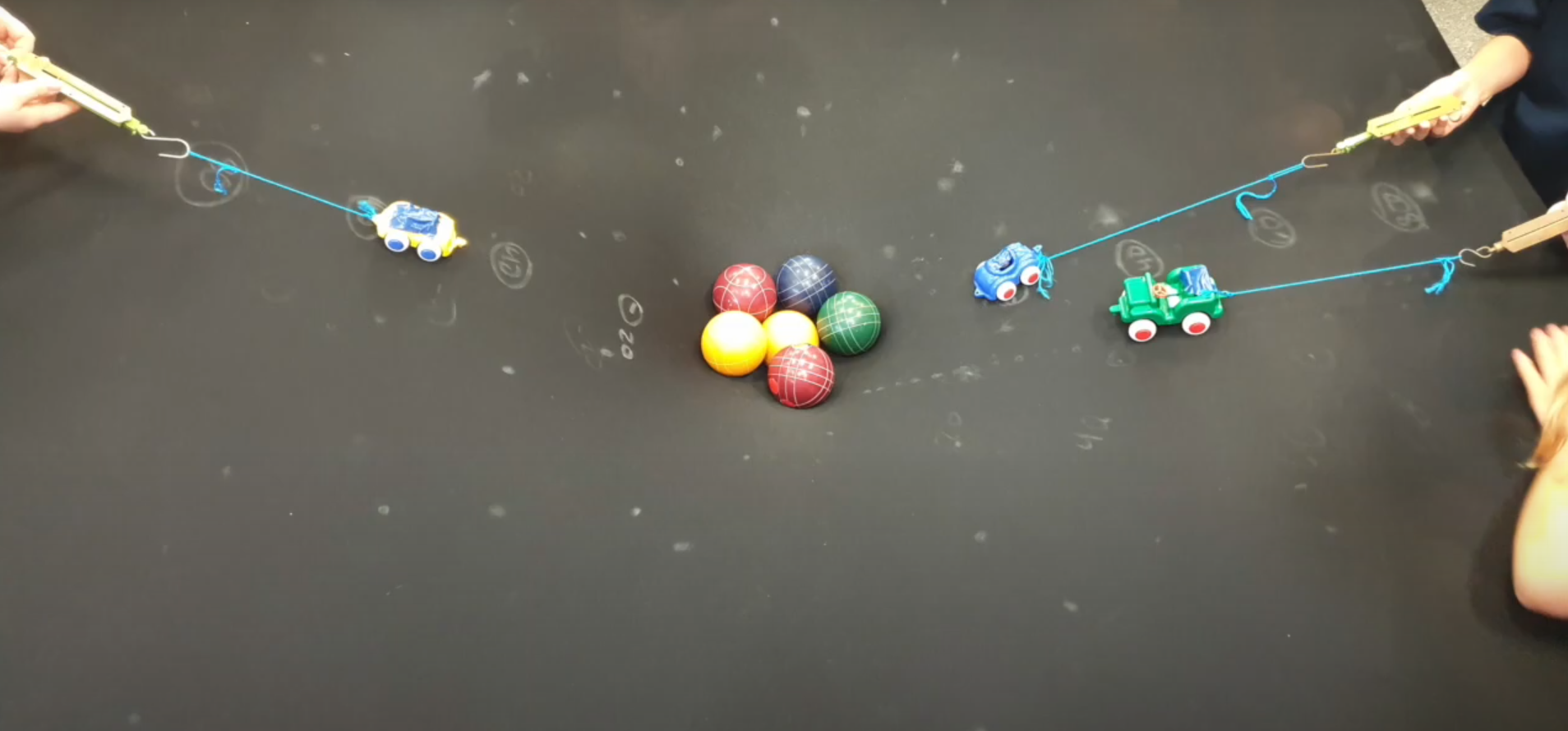
Activity: Measuring the force pulling on the car as it falls: Working in groups of 4 to 6, students explore the relationship between distance from the central mass (the Earth) and the force (in grams or Newtons) needed to support the car at different points along its path.
Students complete the first set of measurements by pulling the car so it is about 1 cm above the Earth and take the first reading. Enter this result in the table.
Repeat at the 20 cm, 40 cm, 60 cm, 80 cm, 100 cm and 120 cm marks.
Then repeat this three more times so you have four sets of readings.
Students find the average force reading at each 20 cm point along the path, plot a graph of force (in Newtons) against the distance from the Earth (cm) and discuss the results in groups and then as a whole class.
Review: Identify and review all new words and complete the class Word Wall.
Students will explore electric forces by experiencing a range of interesting static electricity activities. They will learn about real-life examples of electrostatics in nature.
Introduction: Introduce Lesson 6 by reviewing learning about forces. Demonstrate the example of forces acting over a distance and introduce electric charge. Then present the Lesson 6 learning intentions using the May the Forces be with You PowerPoint.
Review of charges: Briefly review the structure of atoms.
Student activity 1: Exploring electric forces: Students are shown how to create an electric charge on a balloon or cloth. Through the range of activities, they investigate how charges attract and repel each other.
Whole class discussion: Lead a class discussion about examples of static electricity in real life. Introduce the topic through questioning: What is lightning? How do animals use electricity (electric fish)? Can our bodies become charged? How do air filters and electrostatic printers work?
https://www.youtube.com/watch?v=Vrh5FeGUTJA
https://www.youtube.com/watch?v=Cz_uYBx1G5s
Teacher-led discussion: Discuss how scientists found the evidence of static electricity: Story of Benjamin Franklin's Experiment with a Kite (https://en.wikipedia.org/wiki/Kite_experiment).
Student activity 2: Measuring electrostatic force. Investigate the relationship between charges and forces. Students create an electric charge on a balloon and use an electroscope to estimate charge on different objects.
Class discussion: Using their knowledge gained through activities, students explain what happens when electrons are transferred from one object to another and that electrostatic forces operate over a distance.
Review and introduce the next lesson: Identify and review all new words and write them on the class Word Wall and introduce lesson 7.
Students learn about the discovery of lodestone, learn about magnetic and non-magnetic materials, devise a rule for magnets (like poles repel, unlike poles attract), explore magnetic compasses and make their own compass.
Introduction: Draw on students’ prior experiences of and questioning about magnets to introduce magnetic forces and use selected YouTube videos to explain how magnets and magnetism were discovered.
Activity Exploring Magnets: Students work in groups to explore the properties of magnets using a pre-prepared resource box. Properties investigated include:
- magnetic and non-magnetic by classifying materials depending on whether or not they are attracted to a magnet
- magnetic attraction and repulsion using doughnut magnets arranged on a wooden pole
- magnetic fields by using small iron tacks to make magnetic loops between the two magnetic poles
Classroom Discussion: Lead a class discussion about the nature of magnets and how they affect one another. Ask students to work in their groups to write down the key things they have learnt from the different activities completed today.
Optional activity: ‘Seeing’ magnetic fields: Students collect the clear plastic CD case with iron filings sealed inside it using clear tape (make sure no iron filings escape – they make a mess of your magnets!). Place two or three different magnets next to the iron filings and observe what happens to the iron filings. Use what you have learnt about magnets and forces to explain what you see.
Review and introduce the next lesson: Identify and review all new words and start the class Word Wall and explain that in the next lesson we will explore electromagnetic forces which are magnetic forces produced when negatively charged electrons move. This helps us understand that electricity, or moving electrons are what causes magnetism and that magnetic forces are a special type of electrical force.
Extension Lessons
This lesson is an optional extension lesson which explores the concept of electromagnetism by building and testing an electromagnet.
Students make an electromagnet and explore magnetic forces associated with electricity.
Introduction: Review the key points learnt in lesson 7 through questioning, review lesson 8 learning intentions and indicate that we will learn where magnetic forces come from and that magnetic forces are a special type of electric force.
Activity: Exploring the effect of moving electrons on a compass needle: Students work in teams to collect a small pocket compass, battery holder and two batteries and electric leads and small ‘press-on’ switch. They connect the battery, switch and length of wire and place the wire over the pocket compass. They then push the ‘on’ switch to start the electrons moving around the circuit and observe what happens.
Student Activity: Making an electromagnet: Working in groups, students wind wire around a small length of plastic pipe to make a coil. They then connect the ends to a battery and a ‘press on’ switch, press the switch on and see how many tacks it attracts and how it affects a pocket compass needle. They then slide a length of iron into the centre of the coil and repeat the steps. Ask students to watch the following brief 1-minute YouTube video: Electromagnet -What is it? For Kids.
Student Activity: Electric forces hold atoms together: Ask if anyone can remember what holds atoms and molecules together. Then use the Snatoms set to make a water and methane gas molecule and watch the first 1 minute 50 seconds of the Veritasium YouTube video Snatoms! The Magnetic Molecular Modelling Kit.
Review and Post Test: Identify and review all new words, add to the class Word Wall. Have students complete the post-test for the unit if desired.