
May the Forces be With You – Lesson 4 – Einstein’s Gravity
Students use the spacetime simulator to be introduced to gravity. They observe how the distance between two dots changes when masses are added and recognise that the stretching of the fabric represents the stretching of space and time.
Introduction: Using the YouTube video: Newsweek Why Do We Age Slower In Space? Introduce the idea that time varies at different rates for people in different places.
Role-play to introduce the idea that time is relative: With the guidance of the teacher, class members are actors or audience for the brief play Welcome to the Slow Light Universe.
Spacetime Simulator Activities:
- Matter warps spacetime: Students place a few small masses randomly on the spacetime simulator and observe what happens.
- Matter attracts other matter in spacetime: Ask students to work in their groups and gather around the spacetime simulator. Invite one student to place a ball on the spacetime simulator and another to add one more ball about 30 cm away from the first. Observe what occurs. Several pairs can do this. Students then return to their group and discuss why the balls move towards one another. Write their answer on a piece of paper, ask the reporter from each group to read their answer.
- Creating orbits in spacetime: Students then learn how to make circular orbits on the spacetime simulator and practice creating orbits with large and small marbles/ball bearings and of different diameters.
- Musical Jingle: The teacher should display the jingle: ‘Matter tells spacetime how to curve; Spacetime tells matter how to move.’ on their screen and students should say the jingle together.
Teacher-led discussion: Highlighting the key ideas from the lesson
Reinforce key ideas learnt from the play and spacetime simulator activities: that time depends on the strength of gravity; that matter tells spacetime how to bend; that spacetime tells mass or matter how to move; and that gravity is the bending of spacetime.
Review and introduce the next lesson: Identify and review all new words and complete the class Word Wall and explain that during next week’s lesson students will explore gravity again, this time using a marble run and trampoline.
Students will:
- know that matter tells spacetime how to curve and that spacetime tells matter how to move.
- know that gravity is curved space.
Ensure the spacetime simulator is set up and a range of different sized balls are easily accessed.
This lesson requires the following equipment:
- Spacetime simulator; see instructions how to build it here. We recommend a square lycra sheet 2.4m x 2.4m.
- Set of six large metal balls (e.g. mill or boule balls).
- About 20 mid-sized balls (e.g. large ball bearings, large marbles or pool balls).
- About 100 smaller balls (e.g. mid-sized ball bearings or marbles).
- Flexible 1m measuring tape (e.g. Bunnings, IKEA or dressmaker measuring tape).
- Chalk.
This lesson begins with a PowerPoint about the bending of space and time and how time changes as you move further away from the Earth’s surface.
The Newsweek YouTube video Why Do We Age Slower In Space? explains that time is relative. This means that the rate at which time passes can change depending on the gravity you experience and how fast you go. An astronaut orbiting the Earth in space ages slower than everyone here on Earth. But why? This video explains this.
Inform students that we will use an analogy or model to explain gravity by measuring the stretching of the spacetime simulator fabric. We will see how mass bends the fabric of spacetime.
Present the learning intentions for Lesson 4.
Note that this activity could be completed as a drama lesson just prior to this lesson.
Students complete a ten-minute role play: Welcome to the Slow Light Universe
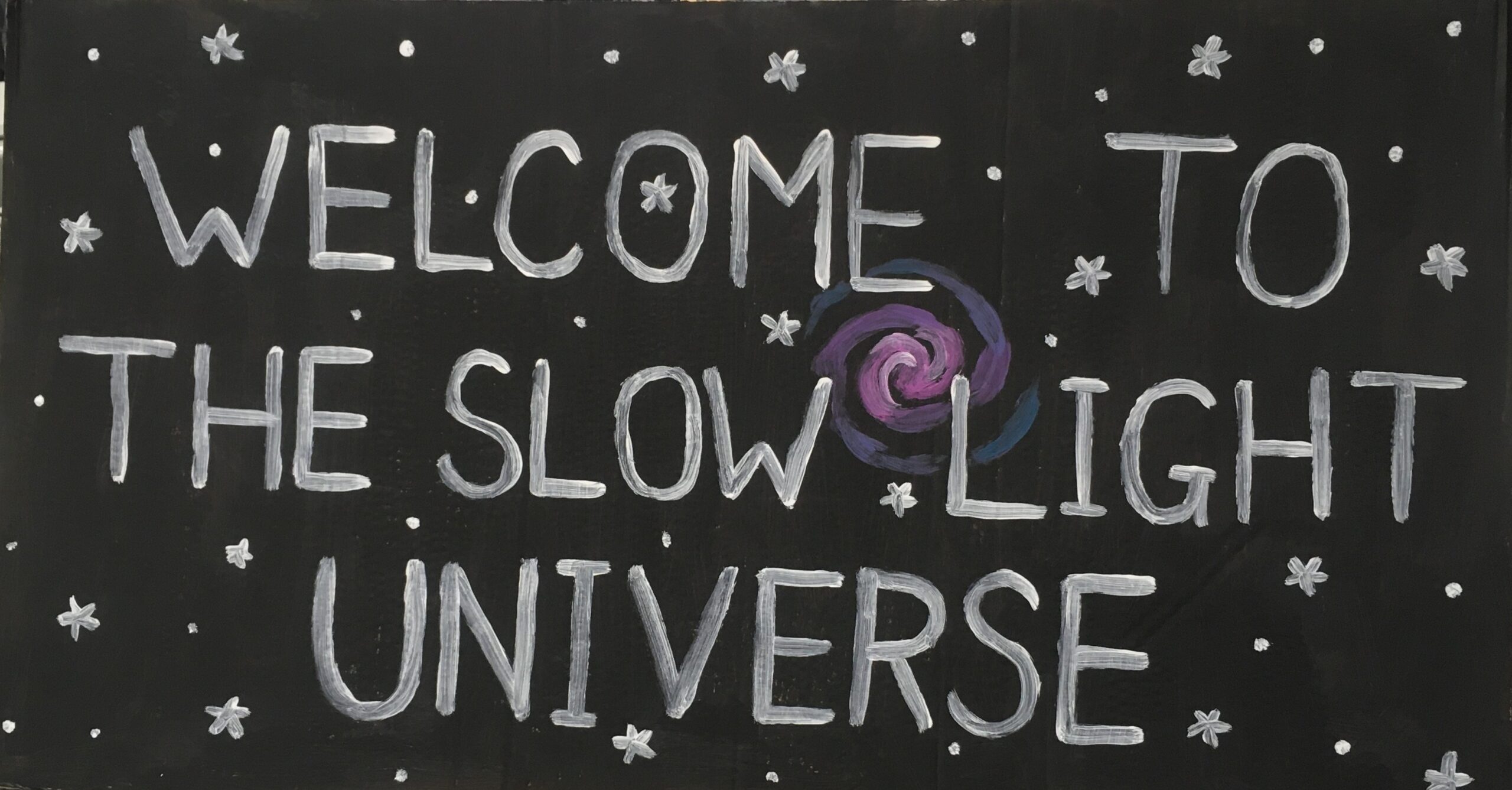
This play shows us that time is not as straight-forward as it seems. We learn that the rate that time passes depends on two things: the speed the person measuring the time is moving and their height above the Earth.
The classroom is arranged as follows:
- it has an entry sign saying: ‘Welcome to the Slow Light Universe’
- there is a toy sit-in car and the car has a sign: ‘Time Stretcher’.
- a ‘tower’ made from a stepladder or “a chair on a tabletop” to allow a student to climb upwards and the tower has a sign ‘Time Warp Tower’.
- there needs to be enough space for the car to be pushed around in a circle.
The following video gives an introduction to the spacetime simulator. Watching it may help you run the activity with your students.
Introduce the spacetime simulator by asking students to stand around it, being sure to stand back far enough so everyone can see.
Show students and explain that the spacetime simulator is a fabric called ‘Lycra’ that has been stretched over a frame. The fabric represents spacetime.
Ask the following discussion questions:
- Who can think of where stretchy fabric is used? Sportswear, tights etc.
- Describe the fabric when there is nothing on it? It is flat.
- What does this represent? It represents flat spacetime.

After the discussion questions students can do the next activities in groups of four.
Ask students to work in their groups. All gather around the spacetime simulator.
Ask one student to put a large ball bearing, marble or pool ball on the spacetime simulator and another student to add another ball about 30 cm away from the first.
- Ask students what they observe? When the first ball is placed on the fabric, the fabric curves into a small indent below the ball. Then when the second ball is placed on it, it also makes a small indent, and then the two balls start to move together until they ‘join up’.

A famous American physicist, John Wheeler, thought of a very easy way of summarising this. He used the following saying to describe Einstein’s theory of Gravity. Ask the whole class to say it aloud. Try to memorise these two short sentences:
Matter tells spacetime how to curve.
Spacetime tells matter how to move.
Now we will see this in action when masses such as large heavy balls are added to spacetime.
Prior to the lesson, place two chalk marks on the spacetime fabric at 20 cm intervals from the centre to one edge. Leave these marks on the spacetime simulator for the next few lessons.
In the beginning, when there was no mass, space was empty and spacetime was flat. Time did not warp, and space did not curve.
How far apart are the chalk marks? Measure precisely and record the value in millimetres.
Have about a kilogram of marbles or small ball bearings and when I say ‘go’, everyone carefully place these somewhere in the fabric.
What do we see happen? The masses move towards each other and then to the centre of the spacetime simulator, the dots towards the centre separate a little.
Now let’s add more masses (have 12 students add an additional 500 grams or half a kilogram (iron mill ball).
What happens now? The fabric stretches more.
What happened to the spacing between the chalk marks? It stretched even more as we added more mass.
How much did the fabric stretch? Did it stretch more closer to the centre or nearer the edge? It stretched more near the centre.
How can we work out how much it stretched? Measure the distance between the dots.
Record these distances on the class whiteboard and in your science journals.
What did this activity show us about the effect mass has on spacetime? Mass tells spacetime how to stretch.
How do our findings relate back to our short play? We observed that space near the Earth stretches a little bit, just like time near the surface of the Earth slows down a little. As we get further away from the Earth’s surface, time travels a little faster and space gets less stressed.
Draw a ‘graph’ of where the chalk marks were before and how the fabric stretched and made the chalk lines separate. What does this show?
Your graph shows the stretching and bending of spacetime as masses are added.
Now that we have learnt that matter tells spacetime how to curve and spacetime tells matter how to move we will practice making circular orbits around the Earth.
Then work in your groups for about five minutes to explore how planets move around the Sun and satellites like the International Space Station and the Moon move around the Earth.
Work together as a group to write a short description explaining why the moon orbits the Earth and doesn’t just fly off into space.
Compare your group’s explanation with my explanation. I will reveal this to you once you have finished! If you think some of your ideas need to be changed then please work together to do a second draft of your explanation.
Gravitational Waves (Optional Extension) – How do we know that we live in a curved space-time?
There are many ways that we know that we live in a space-time which bends and stretches. Scientists observed time slowing down using atomic clocks on satellites, astronomers have seen that light bends around black holes (gravitational lensing), but most recently a Nobel prize was awarded in 2016 for the discovery of gravitational waves. Gravitational waves can be thought of as ripples in spacetime. Show students this video to introduce gravitational waves: Gravitational Waves Explained (3:30).
To show students what this looks like, ask for a student to suddenly but gently touch the fabric of the spacetime simulator. You should see that there is a ripple that moves outwards. You may also be able to observe this if two large masses spiral around each other in the spacetime simulator.
Place a phone or tablet with an accelerometer app (like in the Physics Toolbox Sensor Suite) on the spacetime simulator. When a large ball spirals around another large ball you should see a ‘wobble’ that can be picked up by the accelerometer.
At this point you may want to play the Curved Space Song and have students sing along.
Then you can recap the important ideas which have been introduced in this lesson:
- We learnt that clocks don’t always tick away at the same rate: go tick …. tick …. tick …. tick and so on.
- As they move further away from the Earth’s surface they tick a little faster. If we took a clock to Jupiter, where gravity is about 2½ times the gravity on Earth, the clock will tick a little slower.
- The spacetime simulator is a sheet of stretchy elastic fabric called ‘Lycra’ stretched over a frame.
- Mass tells spacetime how to curve: We measured how much the fabric curved and bent as we added more and more mass.
- Spacetime tells mass or matter how to move. We observed the balls coming together and saw how objects can orbit the Earth if they have just the right speed.
- Gravity is the bending of spacetime.
This was one of Albert Einstein’s great discoveries. These ideas could be elicited from students through careful questioning:
What is a spacetime simulator? The spacetime simulator is a sheet of fabric called ‘Lycra’ stretched over a frame. It gives us a way of visualising gravity.
What is the spacetime fabric like when no mass is present? The fabric is flat.
What happens when we added mass to spacetime? Mass causes spacetime to stretch and curve.
How did we measure how much the fabric stretched as we added more and more mass? We used a flexible tape measure to measure the distance between two marks on the fabric.
Who can remember John Wheeler’s easy way of summarising Einstein’s gravity? Matter tells spacetime how to curve, spacetime tells matter how to move.
Identify and review all new words and complete the class Word Wall.
Explain to students that during next week’s lesson students will explore gravity again, this time near the Earth using the spacetime simulator. We will learn how everything wants to be in free fall and that weight is the force that stops things from falling.
Spacetime: The idea that space and time cannot be separated but influence one another.
Gravity: The curving of space time which makes objects come together.
Spacetime Simulator: A sheet of fabric called ‘Lycra’ stretched over a frame. It gives us a way of visualising gravity.