
May the Forces be With You – Lesson 5 – Gravity Near Earth
In this lesson students will use the spacetime simulator to learn that objects fall to Earth because they follow the curvature of spacetime surrounding it. As they move further away from Earth’s surface, the spacetime becomes less curved.
Introduction: In lesson 4 we learnt that Albert Einstein introduced us to the new idea that gravity is curved spacetime. We saw this when we used our spacetime simulator to show that gravity is curved spacetime. We also learnt that matter tells spacetime how to curve and spacetime tells matter how to move.
Activity: Who can hold their arms outstretched the longest? Ask students to stand with their arms outstretched in front of them. Who can hold this position the longest? They then drop a ball or other small object and in groups discuss observations.
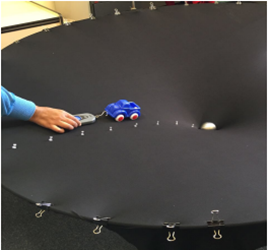
Activity: Observing the toy car fall towards the Earth: Working in groups of 4 to 6, students let the car roll from the outside of the lycra sheet toward the central mass. Discuss what you saw with your group. If students have a tablet or other digital device, ask them to video the toy car’s motion. If it is an option, video using the SloMo video function. Analyse the video of the car’s path from the outside edge to the central mass.
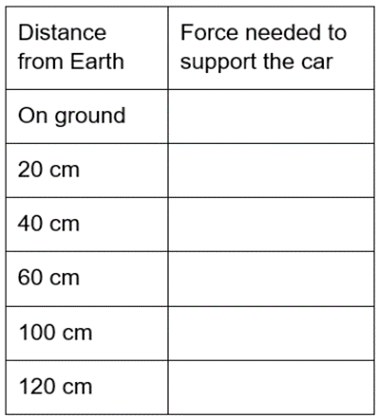
Activity: Measuring the force pulling on the car as it falls: Working in groups of 4 to 6, students explore the relationship between distance from the central mass (the Earth) and the force (in grams or Newtons) needed to support the car at different points along its path.
Students complete the first set of measurements by pulling the car so it is about 1 cm above the Earth and take the first reading. Enter this result in the table.
Repeat at the 20 cm, 40 cm, 60 cm, 80 cm, 100 cm and 120 cm marks.
Then repeat this three more times so you have four sets of readings.
Students find the average force reading at each 20 cm point along the path, plot a graph of force (in Newtons) against the distance from the Earth (cm) and discuss the results in groups and then as a whole class.
Review: Identify and review all new words and complete the class Word Wall.
Students will know that:
- spacetime tells matter how to move.
- When there are no forces everything naturally follows a free fall path, a straight line in spacetime.
- We feel our weight when something stops us from falling.
Ensure the spacetime simulator is set up and a range of different sized balls are easily accessed.
Review the May the Forces be with You PowerPoint.
PrimaryConnections has useful resources for teachers not familiar with word walls and science journals:
- ‘How to use a word wall’
- ‘How to use a science journal’
.This lesson requires the following equipment:
- Spacetime simulator; see instructions how to build it here. We recommend a square lycra sheet 2.4m x 2.4m.
- Set of six large metal balls (e.g. mill or boule balls).
- About 20 mid-sized balls (e.g. large ball bearings, large marbles or pool balls).
- About 100 smaller balls (e.g. mid-sized ball bearings or marbles).
- Flexible 1m measuring tape (e.g. Bunnings, IKEA or dressmaker measuring tape).
- Toy ‘push’ free-wheeling wooden car with good wheels and hook at the front.
- Two spring balances.
- Light string.
- Flexible tape measure or ruler (preferably 1 metre to measure in cm).
- Bathroom Scales.
In our last lesson we learnt that Albert Einstein introduced us to a new idea about gravity. He said that gravity is warped spacetime. We saw this when we used our spacetime simulator to show that gravity is curved spacetime and explained that this is simply a model to represent spacetime.
Another way to imagine what spacetime is like is to use digital animations like is shown in the diagram:
Ozgrav has an online interactive which demonstrates spacetime here. To use this to view spacetime click “Spacetime” on the top left of the screen and then click “Controls” on the bottom right.

While the spacetime simulator is usually used to show curved spacetime and explore the paths of objects orbiting around a central mass, like satellites and the Moon orbiting around Earth or the planets orbiting around the Sun, we can also use it to investigate gravity near the Earth’s surface.
Remember, our spacetime simulator lets us see the effect mass has on spacetime and that spacetime has on mass. It let us see that if we place something heavy on the spacetime simulator it tells spacetime how to bend, and that spacetime tells the object how to move.
Ask students to stand with their arms outstretched in front of them. Who can hold this position the longest?
- What happened when you couldn’t hold your arms outstretched any longer? They fell downwards.
- Why do your arms appear to feel heavier and get harder and harder to hold in this outstretched position? Your arms want to fall towards the Earth.
- What holds your arms up and outstretched? Your skeleton (bones) and the muscles in your arms and shoulders that are connected to your skeleton.
Now drop a ball or other small unbreakable object.
- What happened? It falls towards the Earth.
- Why did the ball fall? The attraction between the ball and Earth resulting from curved spacetime tells matter how to move.
- Why did your arms fall? The attraction between your arms and the Earth because curved spacetime tells matter how to move. Your shoulders provide the force that stop your arms from moving as they naturally would in spacetime.
In this activity, we first need to ‘make our Earth’ by placing a large mass in the centre of the spacetime simulator, maybe 6 to 8 heavy balls.
- What does this do to the fabric which is our model spacetime? It bends or curves it, and the bending is more near the surface of the Earth than it is near the edge of the spacetime simulator.
Working in groups of 4 to 6, students let a toy car roll from the outside of the lycra sheet toward the central mass. Discuss with your group what you saw.
If students have access to a tablet or other digital devices, ask them to video the toy car’s motion. If it is an option, video using the SloMo video function.
Analyse the video of the car’s path from the outside edge to the central mass.
- What do students see happen? The toy car moves further and further in each time frame, which means it gets faster and faster as it moves towards the central mass, or the ‘Earth’.
- What is another word we use in science ‘for gets faster and faster’? Acceleration, that is, the car accelerates.
- Where did we observe the car moving with the greatest acceleration? Just prior to it colliding with the central mass, the Earth.
- Why does the toy car move like this when it is released? Spacetime tells it how to move.
- How could you stop the car from ‘falling’ towards the centre of the Earth? Tie a piece of string to it and pull in the direction opposite to its movement.
In the second activity, we are going to further explore this idea.
The following video demonstrates how to conduct this actvity.
Now we will explore why the car gets faster and faster as it ‘falls’.
- Who can tell me why the car gets faster and faster? The curvature of spacetime increases as the car gets closer to the surface of the Earth. The more the spacetime is curved, the greater is its acceleration.
First, we will find the upwards push force that the Earth has on the toy car by using a spring balance. Record how many grams the toy car weighs.
If your school has bathroom scales, use it to measure the upwards push force that the Earth has on you. Record this in kilograms.
Now we will go back to our spacetime simulator and do the reverse of what we did in the first activity.
- Who can remind everyone what we did? We released a toy car and let it roll from the outside of the spacetime simulator towards the central mass that we are pretending is the Earth.
- So, what would be the reverse of this? Yes, we would start with the toy car sitting on the surface of the Earth, and we would pull it out to the edge of the spacetime simulator using a piece of sting.
Just like we used the spring balance to find the weight force of the toy car and the bathroom scales to measure our weight force, we will use the spring balance to find the weight force on the toy car when it is ‘on the ground’ and then at 20 cm intervals as it is pulled away from the Earth.
Ask students to record their measurements in a table like the one below.
When students have their six measurements, they could draw a dot plot of their results. This will allow students to see the trend.
- What will you need to do to be sure this is a fair investigation? Keep the mass of the toy car the same and be sure to support the weight of the car in the same way each time. We need to stop the car falling back to the Earth by pulling along the direction the car is moving. This needs to be done in the same way each time a measurement is taken.
-
What does the dot plot tell us about how the gravity changes as we move further and further from the surface of the Earth? It tells us that that gravity gets weaker as we get further away from the earth.
-
Why does this happen? The curvature of spacetime becomes less the further you are away from the Earth.
In the following activity we will summarise the main points to conclude the lesson.
Draw out the key points in the lesson by asking students to discuss their findings in groups. Some prompt questions that you could ask are:
- What happened to the distance between the chalk marks as you get closer to the mass? They get more stretched out/further apart.
- What happens to the strength of gravity as you get closer to a mass? It gets stronger.
- What did you see happen when we watched the Slo-Mo video of the car falling into the mass? The car accelerated, got faster and faster.
- What is the force that stops us from being in our natural path in space-time? The force from the floor or the Earth which stops us falling.
Weight Force: Under Newtonian Gravity weight force is the gravitational force which pulls you down.
Weight: Einstein would say that you feel your weight when something stops you from following your natural path in space time.