
May the Forces be With You – Lesson 8 (Extension) – Electromagnetic Forces
Students make an electromagnet and explore magnetic effects of electricity.
Introduction: Review the key points learnt in lesson 7 through questioning, review lesson 8 learning intentions and indicate that we will learn where magnetic forces come from and that magnetic forces are a special type of electric force.
Activity: Exploring the effect of moving electrons on a compass needle: Students work in teams to collect a small pocket compass, battery holder and two batteries and electric leads and small ‘press-on’ switch. They connect the battery, switch and length of wire and place the wire over the pocket compass. They then push the ‘on’ switch to start the electrons moving around the circuit and observe what happens.
Student Activity: Making an electromagnet: Working in groups, students wind wire around a small length of plastic pipe to make a coil. They then connect the ends to a battery and a ‘press on’ switch, press the switch on and see how many tacks it attracts and how it affects a pocket compass needle. They then slide a length of iron into the centre of the coil and repeat the steps. Ask students to watch the following brief 1-minute YouTube video: Electromagnet -What is it? For Kids.
Student Activity: Electric forces hold atoms together: Ask if anyone can remember what holds atoms and molecules together. Then use the Snatoms set to make a water and methane gas molecule and watch the first 1 minute 50 seconds of the Veritasium YouTube video Snatoms! The Magnetic Molecular Modelling Kit.
Review and Post Test: Identify and review all new words, add to the class Word Wall. Have students complete the post-test for the unit if desired.
Students will:
- know that magnetism results from moving electrons.
- make a simple electromagnet.
- Review the May the Forces be with You Lesson 8 Powerpoint.
- PrimaryConnections has useful teaching resources for teachers not familiar with word walls and science journals: How to use a word wall and How to use a science journal
This lesson requires the following equipment for each group:
- Length of insulated copper wire
- Iron block/nail to use as electromagnet core
- Two AA batteries and battery holder
- Small ‘push on’ switch.
- Paper clips
- Compasses
Also one or two Tatoms atoms or Snatoms atom sets (to be shared by the class) or plasticine is required.
In last lesson (lesson 7) we explored magnets and learnt some interesting things about them. Who can recall some of these?
- How were magnets discovered? (a shepherd in Magnesia in Ancient Greece noticed his boot that had iron nails on its sole, stuck to a rock)
- Who can remember the two names of the rock or ore that was discovered/ (magnetite after Magnesia in Ancient Greece and lodestone)
- How do two magnets affect one another? (like poles repel, unlike poles attract)
- How does a compass work? (it lines up with the magnetic field lines of the Earth)
Let’s review the learning outcomes for today’s lesson using our May the Forces be with You Lesson 8 Powerpoint.
Today we will learn where magnetic forces come from and that magnetic forces are a special type of electric force.
Working in your team, collect a battery and switch holder, long wire and small pocket compass you will need to explore the effect of moving electrons on a compass.
Connect the battery and switch holder and wire as shown.
Place the compass on a wooden or plastic desk away from iron so it lines up along the North-South line. Your teacher will help you identify the North-South direction.
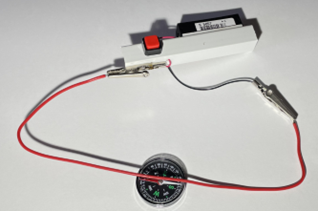
Remind students about our Predict, Observe, Explain strategy.
Predict what will happen when the switch is briefly pressed on.
Then press the switch on by briefly pushing the switch on. Only hold it on for a few seconds.
- What did you Observe? (The compass needle moves.)
Remind students that electrons have a negative charge and that the battery makes the electrons flow around the electric circuit when it is switched on. Then ask students to work in their groups to come up with an explanation of what they observed.
- Who can Explain why this happened? (The electrical current, which is moving electrons, produces a magnetic field around the wire. This interacts with the compass needle’s magnetic field. It produces a small force that makes the compass needle turn.)
This simple activity is very important because it helps explain how electric forces make electric motors work.
Think of as many things as you can that have electric motors in them.
We will now see how we can use this idea to make an electromagnet and we will re-visit it again in Year 6 when we will see how electric motors work and generators produce electricity.
Wind an electromagnet with wire around a small length of plastic or paper drinking straw. Use tape to fix both ends of the wire to stop it unravelling.
Note: The coils may be already wound from previous years or by manufacturer.
Connect ends to the two AA battery and a ‘press for on’ switch.
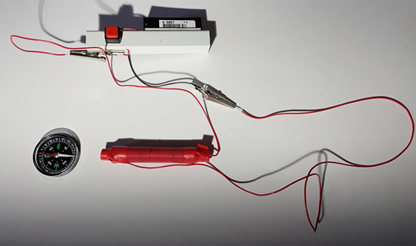
Connect ends to the two AA battery and a ‘press for on’ switch.
- How many small paper clips can your air electromagnet pick up?
- Can it make your compass needle deflect? Why does this happen?
- Can you make your pocket compass spin by switching the electromagnet on and off rapidly?
- Explain how the switching on and off of the electromagnet makes the compass needle spin round and round.
Now slide the iron rod into the centre of the coil and repeat the above steps.
- How many small paper clips can your iron core electromagnet now pick up?
- Did the iron core electromagnet affect the pocket compass more or less? Why does this happen? (The iron concentrates the magnetic field.)
Ask students to again describe what they saw happen.
Ask students to watch the following brief 1-minute YouTube video: Electromagnet -What is it? For Kids. Following the video, summarise the main points for the class
To finish the lesson we will relate electric forces back to chemistry and our Atom Frenzy lessons from Year 3.
- Does anyone remember or know what holds atoms and molecules together? (Electrical forces.)
Our model Snatoms atoms and molecules help us visualise this.
Watch the first 1 minute 50 seconds of the Veritasium YouTube video Snatoms! The Magnetic Molecular Modelling Kit.
As a class or in groups build some H2, O2, H2O and CH4 (methane gas) molecules.
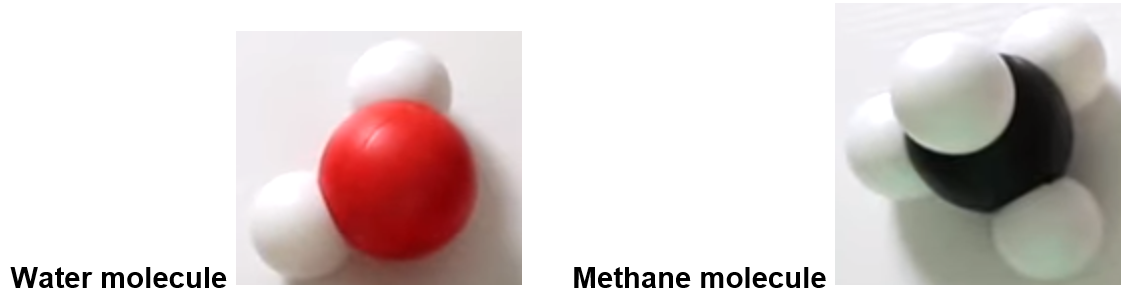
- As you place the atoms together notice the attraction force between the molecules. Where does this force come from?
- Hear the energy given off when you form a new bond.
- Then separate the bonds. Feel the energy needed to pull the atoms apart and break the bond.
Using their knowledge gained through activities, students explain what happens when electrons are transferred from one object to another and that electrostatic forces operate over a distance.
Identify and review all new words and start the class Word Wall.
Inform students that in the next lesson they will answer questions about what they have learnt about heat and also about whether they liked the way it was taught to them. In the following lesson administer the May The Forces be with you Post-test (Marking Guide) and Student Attitude Questionnaire.
Molecule: Two or more atoms held together by electrical forces.
Element: A pure substance made from the same type of atoms that cannot be broken down by a chemical reaction into simpler substances.
Compound: A pure substance made when two or more elements combine.
Hydrogen molecule: A molecule made from two hydrogen atoms.
Hydrogen: A pure gas made from hydrogen molecules.
Oxygen molecule: A molecule made from two oxygen atoms.
Oxygen: A pure gas made from oxygen molecules.
Nitrogen molecule: A molecule made from two nitrogen atoms.
Nitrogen: A pure gas made from nitrogen molecules.
Water molecule: A molecule made when two hydrogen atoms combine with one oxygen atom.
Water: A pure substance made from water molecules.
Carbon dioxide molecule: A molecule made when one carbon atom combines with two oxygen atoms.
Carbon dioxide: A pure gas made from carbon dioxide molecules