
May the Forces be With You – Lesson 3 – Combining Forces
Students investigate two-way, three-way and four-way pull forces with rubber bands. Using a wooden block and rubber bands, they use arrows to show the forces’ directions and learn how to add and cancel these forces through the activity with the block. They then make a ‘Cartesian Diver’ and apply their knowledge of forces to a floating object.
Introduction: Explain that today we will be looking at forces and find out how to add two or more forces together. Before doing this remind students of key ideas about the nature and measurement of forces from lessons 1 and 2 particularly that forces have both a size and a direction.
Discussion: When we apply a force to an object, we can cause it to accelerate and move. If we add another force, we can make the object be still, move it in a different direction or even move it faster. It all depends on the direction of the new force. Show how arrows help us work out what direction an object might move and introduce the rule for adding arrows: Put arrows head to tail. The arrow needed to fill the gap between the start of the first arrow and the tip of the last arrow is the sum of all the forces.
Activity 1: Rubber band Forces: Students then work in their groups using wooden blocks and rubber bands to look at different forces and their directions, recording each trial on a piece of butcher's paper or whiteboard. There is a detailed set of instructions that give students the opportunity to explore single forces, two forces acting in the same direction and two forces acting in opposite directions.
Optional Extension Activity: Adding forces in two dimensions: There is an option to extend this to forces in two dimensions.
Activity 2: Cartesian Diver: In this activity students make a Cartesian diver and then explore the forces on it as the pressure in the water causes the weight of the diver to change.
Review and introduce the next lesson: Identify and review all new words and add these to the class Word Wall and explain that in the next three lessons we will briefly introduce you to electrical forces.
Students will:
- know that forces are represented by arrows
- use arrows to represent forces and show how the forces add or cancel according to their size and direction
- analyse force diagrams to state if forces are balanced causing an object to not move, or unbalance causing an object to move.
- Gather materials for the activities (see equipment)
- Access to water to fill your container
Block activity:
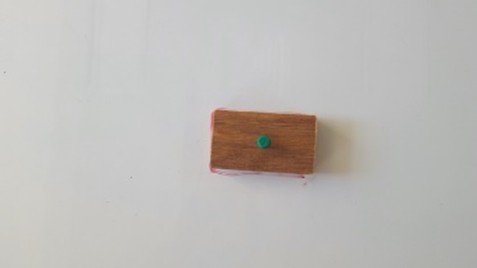
- Block with pin in top
- Three identical rubber bands
- Butcher’s paper
- Marker pens
Materials for the Cartesian diver:
- Pen lid (or other small object that can hold an air bubble – 3 cm length of straw, soy sauce fish)
- Small container to test diver flotation
- Larger container with lid (or glass jar with silicone or rubber cover, something flexible and strong, maybe a stretched balloon?
- Blu-Tack (or weight – paperclip, etc.)
Today we will be looking at forces and how to add two or more forces together.
- What is the unit used to measure force? Newtons.
- How do we measure forces? With a force measurer. Sometimes people use a scale to measure the force of gravity (weight).
Like distances, forces can have different sizes. You can run a long distance, or a short one. In the same way, you can have a large force or a small force (e.g. big push or a small push).
Ask a student to come up to the whiteboard and demonstrate a big push force and a small push force against the whiteboard.
- What direction is the student pushing? Towards the board.
Ask a second student to come up and join the first student. Ask students to push hands against each other – we don’t want the students to push each other over or away from one another – we want them balanced, see the image below.
- What direction is Student A pushing now? Draw this direction on the whiteboard as an arrow – or use magnetic arrows if provided.
- What direction is Student B pushing now? Draw this arrow opposing the first arrow.
- Are the students moving? Why not? Because they are pushing the same – lead to the idea that the arrows are the same length, but in the opposite direction, so they cancel.
- If one student pushed harder, what would happen to the force arrows? Would they still be balanced? One arrow would be larger than the other. They would not be balanced.
- Is there a total force in any direction? Yes, the direction of the large arrow.

When we apply a force to an object, we can cause it to move. If we add another force, we can make the object be still, move it in a different direction or speed up (accelerate). It all depends on the direction of the new force.
These arrows help us work out what direction an object might move:
The rule for adding arrows is to put them head to tail. The arrow needed to fill the gap between the start of the first arrow and the tip of the last arrow is the sum of all the forces. You will see how arrows can add up, even to zero.
To practice using force arrows, we have an activity using a wooden block and rubber bands.
Instead of using our bodies like in Lesson 1 with the tug-of-war, we will be using wooden blocks and rubber bands to look at different forces and their directions. Students will work in small groups (3-4 students per group) and use a piece of butcher’s paper, or a whiteboard.
The full steps students will go through are below, and an example worksheet is provided. Students take it in turns being student A, student B and student C.
Step 1: Start – Single Force Demonstration
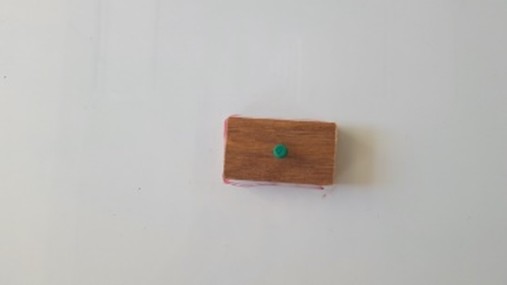
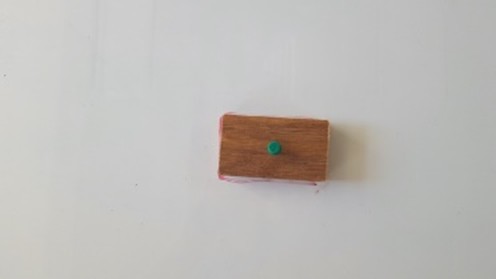
Place the block on top of the butchers’ paper on your desk and trace around it, this will be the starting position.
Step 2: Student A holds, Student B pulls.
Student A holds the block firmly in place. Student B then loops the rubber band around the pin and slowly pulls the block in one direction.
This causes the rubber band to stretch. However the block does not move because student A is holding it in place.
Step 3: Student B keeps hand still, Student A releases!
Student B keeps their hand still, holding the rubber band tight. When ready, Student A releases the block and it moves!
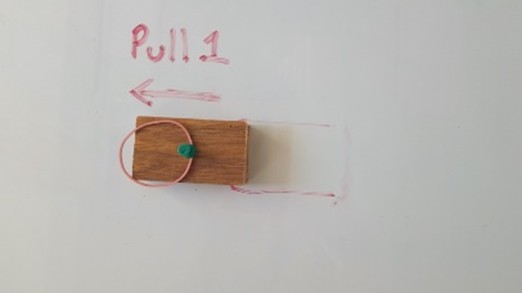
At this point B should be holding a loose rubber band around the block as shown in the diagram on the right.
What was the size and the direction of the pull force?
Answer: To the left, and the size of the stretch of the rubber band.
Step 4: Student C draws the force.
Student B lets go of the rubber band leaving the block where it is.
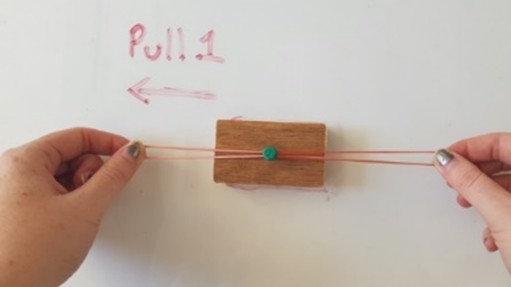
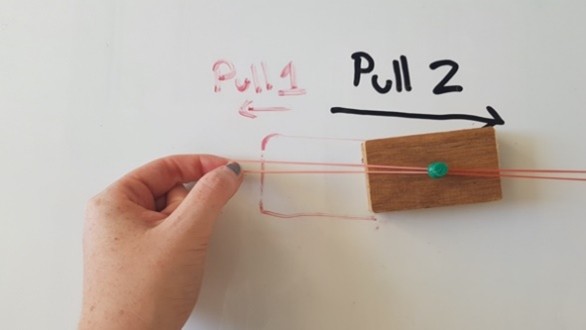
Student C then draws an arrow showing the direction of the force on the block. Student C labels this force ‘Pull 1’.
Step 5: Reset for Two Forces in the Same Direction
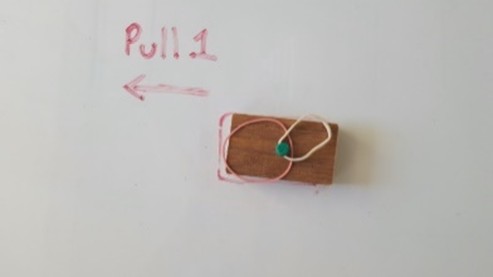
Return the block to the starting position. Student A holds the block in place, this time with two rubber bands over the pin.
Step 6: Student A holds, Students B and C pull in the same direction.
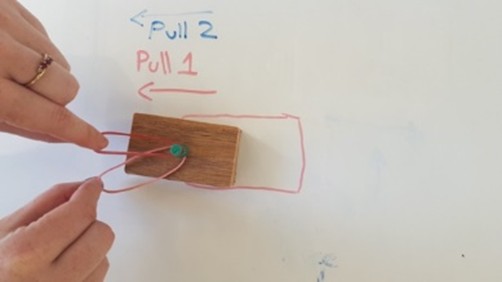
While Student A holds the block, Student B and Student C take one of the rubber bands each and pull them in the same direction and stretch them by the same amount.
What is the size and the direction of the second pull force?
Answer: To the left and the same size as the first force.
Step 7: Student A releases!
Students B and C keep their hand still, holding the rubber band tight. When ready, student A releases the block, the unbalanced forces cause it to move again.
Step 8: Draw the Math of Arrows
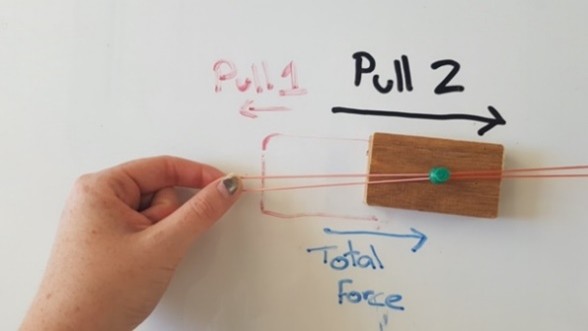
Draw an arrow showing the direction of the force and label it ‘Pull 2’.
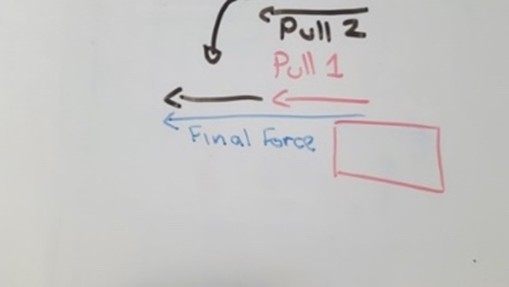
We use the two individual force arrows to find the size and direction of the final force arrow using the maths of arrows.
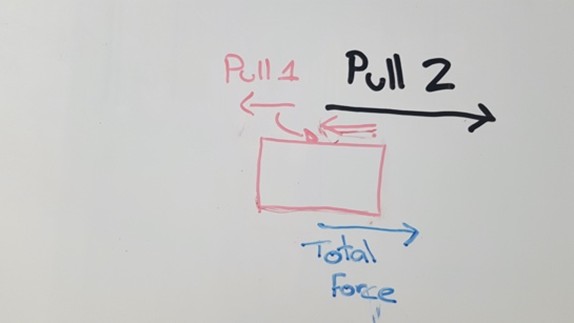
Redraw the ‘Pull 2’ arrow so that its tail is at the head of the ‘Pull 1’ arrow.
Draw another arrow from the tail of ‘Pull 1’ to the head of ‘Pull 2’. This is a ‘Final Force’ arrow.
Step 9: Reset for Opposite Forces
On a new piece of paper, trace around the block again.
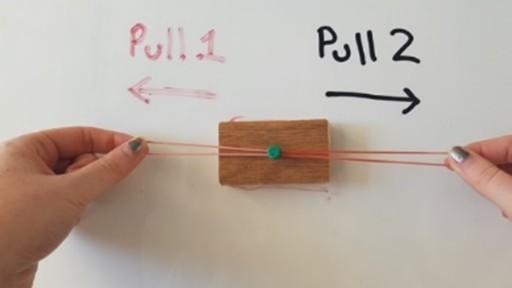
Step 10: Student A holds, Students B and C pull in the opposite direction.
While Student A holds the block, Student B and Student C take one of the rubber bands each and pull them in the same direction and stretch them by the same amount.
Step 11: Label the Forces
While the block is being held by Student A,
Student B and Student C should be pulling with forces of the same size but in opposite directions.
Student B labels their pull force.
Student C then labels their pull force.
Step 12: Student A releases!
Student A releases, but the block doesn’t move very much.
Why doesn’t the block move when both ‘Pull 1’ and ‘Pull 2’ are the same?
Answer: The block doesn’t move, because the forces are balanced.
On butcher’s paper describe what you saw happen and why.
What is the direction of our final force arrow? Can you draw it?
Answer: There is no direction of the final force, cannot draw it.
Step 13: Reset for Opposite Unbalanced Forces
On a new piece of paper, trace around the block again.
Step 14: Student A holds, Students B and C pull.
While Student A holds the block, Student B and Student C take one of the rubber bands each and pull them. This time Student C pulls much more than Student B.
Step 15: Label the Forces
While the block is being held by Student A,
Student B and Student C should be pulling with forces of different sizes in opposite directions.
Student B labels their pull force.
Student C then labels their pull force. Their arrow should be bigger than Student B’s.
Step 16: Student A releases!
Student A releases, the block moves towards Student C’s hand.
Are the forces the same this time?
Answer: No. One is much smaller than the other
Has the block moved from where it started?
Answer: Yes, it has moved in the direction of the larger force (bigger arrow).
Why?
Answer: The bigger pull has more force than the smaller one, the final force is the big arrow minus the small arrow.
Step 17: Label the Total Force
Student C labels the total force by drawing the force arrows from head to tail.
Does the ‘Final Force’ match with the direction the block was moving in?
Answer: Yes. The direction of the final force decides what direction the block moves.

Extra things to try (if there is time):
- Try some other directions.
- What if you have two pulls in one direction and one pull in another?
Reminder: To add arrows, move the tail of one, to the head of another without changing the directions.
See the optional extension for more ideas.
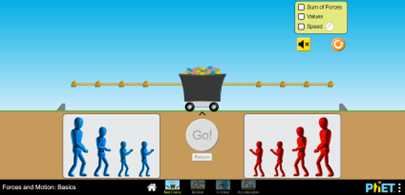
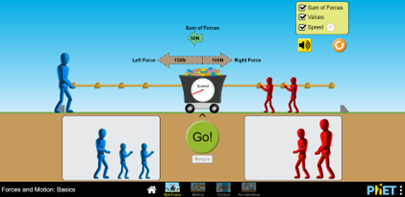
Using a tablet or laptop, explore the PhET Forces and motion basics simulation to review the main ideas we explored with our blocks:
https://phet.colorado.edu/sims/html/forces-and-motion-basics/latest/forces-and-motion-basics_en.html
Simply explore by dragging and dropping the red and blue ‘people’ onto the rope, tick the values so you can see how their forces add, their values and the speed the cart travels and press Go!
Identify and review all new words and add these to the class Word Wall.
Explain that in the next three lessons we will briefly introduce you to electrical forces. In lesson 4 we will explore static electricity, in lesson 5 we will explore magnetic forces and in lesson 6 you will learn that both magnetic and static electricity are both the result of electrical forces. Static electricity comes about when objects are charged, and magnetic forces result when electrons (charges) move.
What would happen if the forces don’t all act along the same line, or in one-dimension? What happens if they act in two-dimensions?
Working in your group, use your elastic bands to see what happens to the block (stationary or moves in a particular direction) for the two set-ups shown in the following diagram.
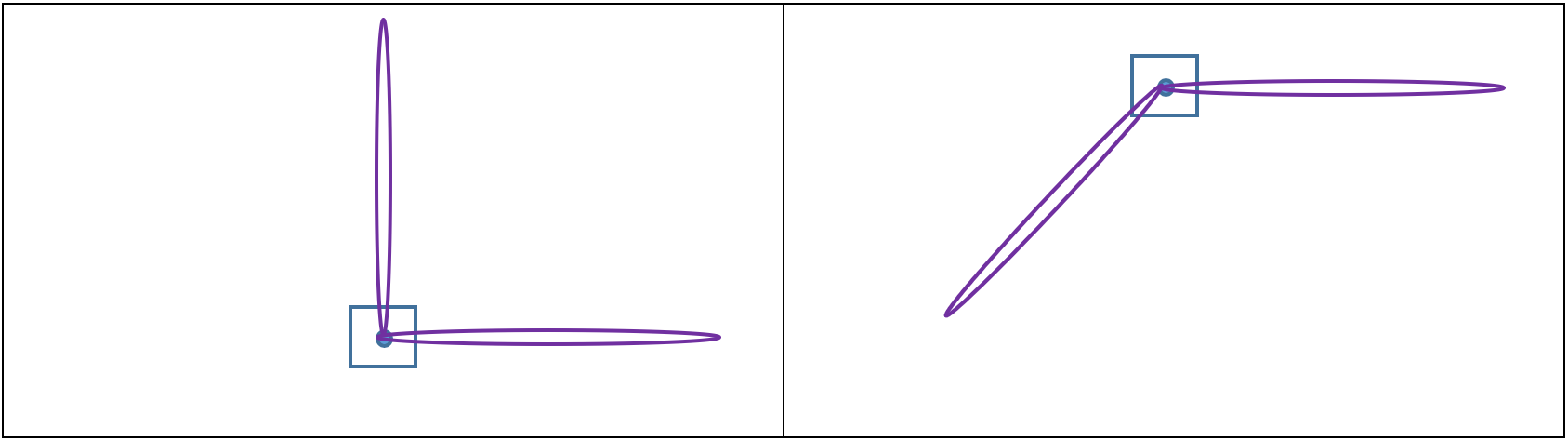
What was our rule for adding arrows? Draw the first force arrow on the paper, then draw the second force arrow starting from the tip of the first arrow. The resultant force is then the arrow from the tail of the first arrow to the tip of the second arrow.
Does this simple rule that we devised for adding arrows in one-dimension still apply for two-dimensions? Yes
Draw force diagrams for each setup on your sheet of butcher’s paper to show the resultant force and the direction the block will move.
Now repeat for when three elastic band forces act as shown.

Does the same rule still apply for two-dimensions when three forces are pulling on the block?
In this activity we will again be looking at forces and how to balance them. To do this, we are going to make a Cartesian diver. A Cartesian diver consists of a bottle filled with water and an object that can float under the water with an air bubble in it, just like a diver. The diver can be made from a pen lid, piece of a straw etc.
Depending on available resources, either make an individual or a group Cartesian diver by following the instructions below.
The video on the right also illustrates the process.
Making a Cartesian Diver
Cover the top of a pen lid with Blu-Tack to block the top hole or fold a small piece of straw in half.
Place Blu-Tack on the bottom of the lid (ideally on the long stem, or around the base). This is to add weight to the lid so it will sit vertically in the water (Similar with the straw, or you can use a paper clip to keep the straw bent).
We want it to sit just on top of the water, not to sink to the bottom. Add small amounts of Blu-Tack until the object just sinks, then take the last bit away. Do this step in a small glass of water.
Fill the larger container with water.
Place the ‘diver’ in the large container, it should float. If not, repeat after reducing the amount of Blu-Tack in the smaller container.

To close the large container, slightly squeeze it, then slowly put the lid on while releasing the bottle.
Once closed, test the diver by squeezing the bottle. The diver should fall to the bottom, then rise again once the bottle is released.
Discussion
Simple explanation
This activity investigates balanced and unbalanced forces. When the forces are balanced, like with the block, the pen-cap diver doesn’t move. We change one of the forces by squeezing the bottle, this makes them unbalanced and causes the cap to move.
Squeezing the bottle changes the volume of the air in the pen cap, similar to when you are in a pool and sitting on top, then let out air from your lungs, then you sink to the bottom. The forces have become unbalanced as you release the air, then balance again when you are sitting stationary on the bottom holding your breath.
Detailed explanation
In this activity we are investigating balanced and unbalanced forces. The buoyancy force is an upward force that depends on the density of the liquid, gravity and the volume of the object floating.
When the diver is stationary the buoyancy force is equal to gravity, nothing is moving. This is the same whether the ‘diver’ is at the bottom or the top of the bottle. If it isn’t moving the forces are balanced.
When we squeeze the bottle, we increase the total pressure in the bottle. This increases the amount of water inside the pen top ‘diver’ and decreases the volume of the air bubble in it. This decrease in volume of air trapped in the diver causes the buoyancy force to decrease. When this happens, the extra water makes the diver desner and therefore heavier overall.
This means the forces are unbalanced, the force due to gravity is bigger than the buoyancy force, and the diver sinks.
Releasing the bottle, decreases the pressure, increases the bubble size and increases the buoyancy force, and the object will move upwards due to the imbalance of forces.
Total Force/Net Force/Final Force: The overall force when all forces are added together using the Maths of Arrows.
Balanced Forces: When the total force is zero, or nothing, because all forces cancel each other out.
Normal Force: The force that stops you falling through the floor (or the wall when you lean on it). Normal forces stop one object from passing through another.
Buoyancy Force (if doing Cartesian Diver): The force that makes things float in water. It is caused by the water being pulled down by gravity, effectively pulling submerged objects up.