
May the Forces be With You – Lesson 2 – Force Measurer
Students use rubber bands looped together to make a force measurer using a short length of wood, string, plastic cup and ‘standard’ weights (e.g. 20 grams). They then use it to weigh different objects. Finally, they explore how different forces affect how far an object moves.
1.) Introduction: review the words used in the previous lesson and complete and mark the jumbled word quiz.
2.) Discussion: Explain that we will make a simple force measurer, but before doing that we need to be introduced to the unit used to measure force, the newton. Students need to be reminded about using units in science or mathematics when measuring things, referring to units used to measure distance, mass or weight and time.
3.) Optional Activity: The students now work in groups to:
a) make a simple force measurer from a piece of timber, elastic band, paper clip, string, heavy nuts or other known masses, and plastic cup by:
- following the set of instructions
- using ‘standard’ masses such as heavy 20- or 50-gram masses to add the scale (or calibrate) the force measurer in newtons
b) use their force measurer to measure the gravitational force on several objects.
4.) Investigation: Students then work in their groups to design and conduct an investigation using their force measurer and a block launcher to explore how blocks of different mass move if they are pushed with the same force. Students should relate this back to their ‘imagine’ experiment from the first lesson where students imagined they pushed the teacher’s car and also a loaded brick truck.
5.) Review and introduce the next lesson
Identify and review all new words and start the class Word Wall and let students know that in the next lesson we will briefly explain how forces can combine following the maths of arrows.
Students will:
- know that force is measured in Newtons (N) and that on Earth, 100 grams has a weight force of 1 N and 1 kilogram has a weight force of about 10 N.
- explain that the larger the force, the faster an object that is free to move will go and the further it will travel.
- Review the May the Forces be with You PowerPoint.
- PrimaryConnections has useful teaching resources for teachers not familiar with word walls and science journals.
Per Group:
- Spring Balance
- 20 gram weights (e.g. heavy nuts), alternatively 50 g slotted masses
- Wooden block launcher
- Blocks to be launched by the block launcher
If you wish to build force measurers then you need the following equipment instead of a spring balance:
- Short piece of string for hanger
- Piece of wood about 30 – 40 cm long and 5 cm wide
- Rubber bands
- Large bent paper clip
- Plastic cup
- String to hang plastic cup from
In Lesson 1 we saw how forces relate to how we play sport and have fun. Let’s review the words we used in the last lesson. The Forces jumbled word quiz could be used.
Discussion
Today, we will learn about how we measure force, and we will make a simple force measurer.
- What do we mean when we talk about units in science or mathematics related to measurement? A unit is a standard or particular amount of a quantity such a length, time or mass that needs to be defined and understood by everyone for it to be useful.
- What is our ‘standard’ used to measure distance? Metre, and from this comes cm, mm, km.
- What is our ‘standard’ for measuring time? Second and from this comes minute, hour, day, week, year.
- Why do we need units? Reproducibility of experimental results is necessary in scientific investigations. A standard system of units allows us to achieve this.
We will now build a force measurer and introduce to the unit the Newton, named after the famous British scientist Sir Isaac Newton.
Warning: This activity can be very tricky for the students which is why it has been included as an optional activity. The activity does not always work well if the rubber bands are too old. Also, it can be difficult for students to construct the force measurers and take a lot of time to complete the activity.
The video below shows how to build and use the force measurer.
Note, the video above describes a force measurer suitable for small masses, measuring up to about 100 g, with each 10 g increment corresponding to about 0.1 Newtons. You may prefer to introduce whole numbers of Newtons with 100 g intervals, following the instructions below. For these large forces, it’s important to start with the maximum mass to let the rubber bands stretch out a little before measuring the zero point.
Working in groups, students make a rubber band force measurer that measures up to 5 Newtons:
Collect the required materials (wooden board with some small eye hooks, length of string, plastic cups with three small holes to tie string support to, one large and one small paper clip, access to set of pliers and sharp pencil or marker.
Follow the six construction steps in the diagram opposite.
The next step is to make the scale on your the force measurer by following Steps 7 to 14 below:
Step 7: Place the full load in the plastic cup (500 g) to stretch the elastic band to show the largest amount of force to be measured.
Step 8: One team member holds the force measurer by the rope handle and let the piece of wood, elastic band, string and loaded cup fall so they are straight up and down (vertical)
Step 9: Another team member carefully lines up the paper clip bent into the ‘dial’ and the wooden block and put a pencil mark at this spot.
Step 10: A third team member repeats Step 9 to be sure the amount of stretch is the same. Repeat a few more times if needed.
Step 11: When all team members are satisfied that the mark is accurately placed, draw a small line across the wood at that point and use a marker to show 5 N (if using 500 g with the double elastic band).

Making the force measurer
Step 1: Loop string or rope through the top hole and tie. This is the hanger.
Step 2: Loop the double elastic band through the top hook.
Step 3: Check the bent paper clip works as the marker.
Step 4: Tie the string supporting the cup to the bottom of the paper clip.
Step 5: Thread the support string through the bottom hook.
Step 6: Tie the string to the cup hangers so the cup hangs freely down as shown.
Step 12: Take out 100 g so 400 g remains in the cup and repeat steps 7 to 11. The weight force on 400 g is about 4 N.
Step 13: Repeat for 3 N, 2 N and 1 N, making a neat, clear mark on the wood each time.
Step 14: Finally, check the zero point and mark it clearly.
Place your group members’ names on your force measurer. We will use your force measurer throughout the year.
Now take the plastic cup off and replace it with a hook. You can use your force measurer with either the cup or hook.
If you have time in class, or at home, you may also like to make a zero to 1 Newton (to measure small forces up to about 100 g weight) using a single strand of ‘soft’ rubber band instead of the double-looped rubber band.
If students did not construct a force measurer, you can instead provide students with 1 or 5 N spring balances.
- Working in their teams, students weigh six objects from the collection of objects to be weighed.
- Students make sure they hold the force measurer and object being weighed steady so they are straight up and down, or vertical.
- Let each team member have a few turns. Other team members then check their readings.
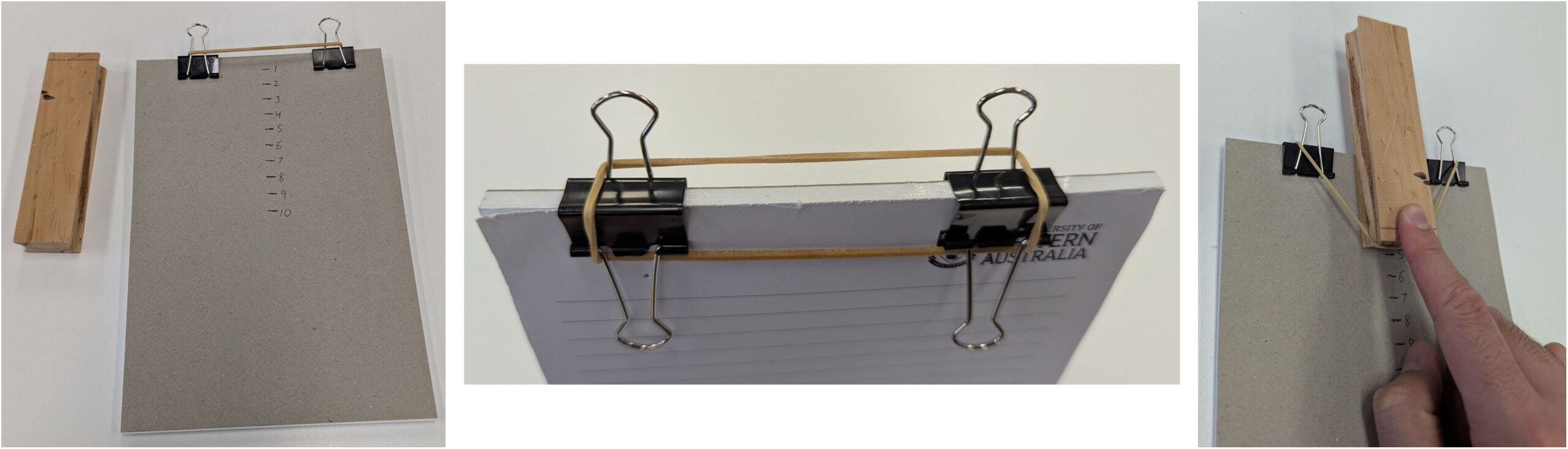
Block launchers can be made by cutting a small section of wood (~10 cm) out of a flat piece of wood. Place a small nail or screw with a broad head (preferrably rounded to avoid sharp edges) on either corner and stretch a rubber band across. It is useful to also mark a cm scale along the cut section.
If you don’t have access to e.g. a woodworking teacher, handyperson, or parent volunteer, you can simply use a thin flat piece of wood or an A5 pad or notebook. Attach the rubber band with small foldback clips as show below, and rule out cm marks. Just be aware that the block will skip a bit as it comes off the end, reducing the friction, although this should not significantly impact results.
You may choose to present that activity directly as laid out in the video above, or you may lead student through more of an open investigation as outlined below.
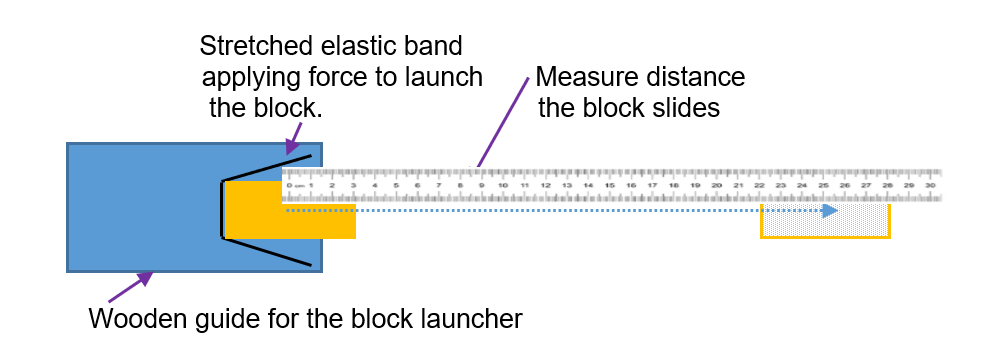
- Use your force measurer (or spring balance) and the block launcher to explore how blocks of the same mass move if they are pushed with different forces.
Working in your group, use the investigation template to design an investigation to find the relationship between how far a block being launched slides and the force being used to push the block.
Students should relate this back to their ‘imagine’ experiment from the first lesson where students imagined they pushed the teacher’s car and also a loaded brick truck.
Discuss the investigation with the class:
- Which force makes the block start moving? The pull force from the elastic band.
- Which force makes the block slow down and stop moving? The friction force.
- When you use more rubber band force, how does this change the distance the block moves? The more rubber band force, the greater the distance.
Review the key learnings from the learning intentions:
- know that force is measured in Newtons (N) and that on Earth, 100 grams has a weight force of 1 N and 1 kilogram has a weight force of about 10 N.
- explain that the larger the force, the faster an object that is free to move will go and the further it will travel.
Identify and review all new words and add to the class Word Wall.
Briefly explain that in the next lesson we will briefly explain how forces follow the maths of arrows.
Optional Task 1: Propelling Toy Cars
Students can test out their findings using toy cars or a trolley with long rubber bands that are looped together. They should relate this back to their ‘imagine’ experiment from the first lesson where different numbers of students pushed the teacher’s car. How does the toy car or trolley speed up? How far does it travel before it stops?
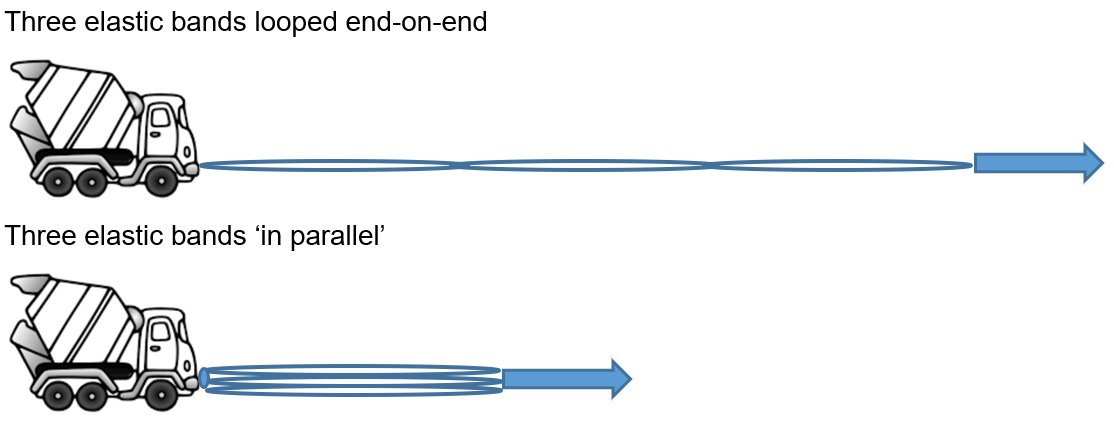
Explore using different combinations of elastic bands, one where they are looped end-on-end and the other where they sit alongside one another ‘in parallel’.
Optional task 2: Explore how far blocks of different mass move if they are pushed with the same force
This could be set as either a written task, an additional investigation or a class investigation that could be submitted for assessment.
Use the block launcher, force measurer and blocks of different mass to explore how the same force applied to the different blocks affects how far each block moves. Again, relate this investigation to your ‘imagine’ experiment from Lesson 1.
Appendix 2 is a worksheet that could be completed as a group activity (i.e. each group submits a group response) or it could be completed independently to assess students’ understanding of the science investigation process.
Newton: The standard unit of measurement of force. One Newton is roughly the weight of a medium apple, or 100 grams
Elastic Force: The force that an elastic band applies when it is stretched. (Note that this force comes from atoms pushing each other, so it is technically a type of electrostatic force)
Gravity/Weight Force/Gravitational Force: The force that pulls objects with mass together. On the Earth’s surface we are pulled down towards the centre of the earth.
Force Measurer: Something that measures forces. A scale is a force measurer, even though lots of people use it to measure mass.