
May the Forces be With You – Lesson 7 – Magnetic Forces
Students learn about the discovery of lodestone, and magnetic and non-magnetic materials, devise a rule for magnets (like poles repel, unlike poles attract), explore magnetic compasses and make their own compass.
Introduction: Draw on students’ prior experiences of and questioning about magnets to introduce magnetic forces and use selected YouTube videos to explain how magnets and magnetism were discovered.
Activity Exploring Magnets: Students work in groups to explore the properties of magnets using a pre-prepared resource box. Properties investigated include:
- magnetic and non-magnetic by classifying materials depending on whether or not they are attracted to a magnet
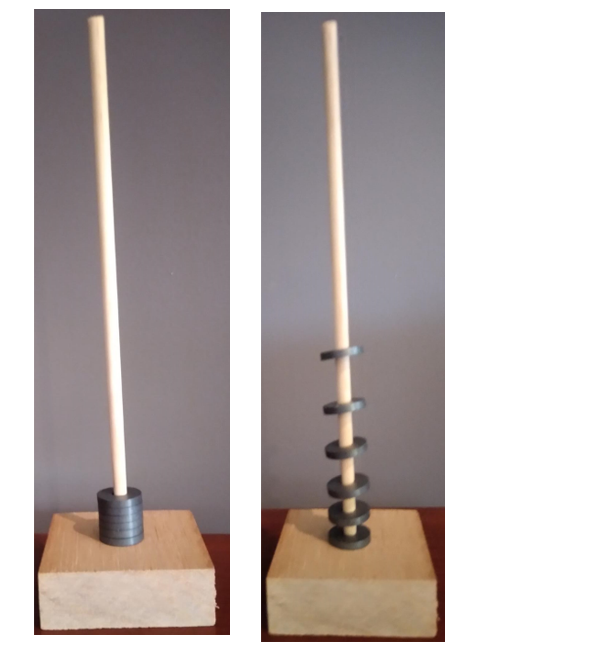
- magnetic attraction and repulsion using doughnut magnets arranged on a wooden pole
- magnetic fields by using small iron tacks to make magnetic loops between the two magnetic poles
Classroom Discussion: Lead a class discussion about the nature of magnets and how they affect one another. Ask students to work in their groups to write down the key things they have learnt from the different activities completed today.
Optional activity: ‘Seeing’ magnetic fields: Students collect the clear plastic CD case with iron filings sealed inside it using clear tape (make sure no iron filings escape – they make a mess of your magnets!). Place two or three different magnets next to the iron filings and observe what happens to the iron filings. Use what you have learnt about magnets and forces to explain what you see.
Review and introduce the next lesson: Identify and review all new words and start the class Word Wall and explain that in the next lesson we will explore electromagnetic forces which are magnetic forces produced when negatively charged electrons move. This helps us understand that electricity, or moving electrons are what causes magnetism and that magnetic forces are a special type of electrical force.
Students will:
- explore the forces of attraction and repulsion between magnets
- know that like poles repel and opposite poles attract
- explain how magnetic compasses can be used for navigation
- Review the May the Forces be with You Lesson 7 Powerpoint.
- PrimaryConnections has useful teaching resources for teachers not familiar with word walls and science journals: How to use a word wall and How to use a science journal
Warning: Strong magnets can be dangerous. Only provide Year 4 students with magnets which they can handle safely. We do not recommend using neodymium magnets for Year 4.
Each group is to be provided with a Magnetism Discovery Bag containing:
- 1 set common materials to test to see whether they are magnetic or not. Include a few metals which are both metalic and non-metalic, plastic and wood. You could also try water or other materials.
- 2 magnets (bar or horseshoe ceramic)
- 1 small container of small iron tacks
- 5 donut magnets with poles marked with red and blue paint
- 1 small pole and base for donut magnets
- 2 pocket compasses
- 1 polystyrene foam disk
You will also need:
- 1 cup of water – almost full to float the foam disk
- 1 old CD case with iron filings sealed inside
Draw on students’ prior experiences to introduce magnetic forces by asking:
- Who has played wtih magnets?
- Can anyone tell the class something they already know about magnets? (Pick up iron things, affect one another)
- Who can tell the class somewhere magnets are used? (compass needles, door catches, regrigerator door seals, fridge magnets, signs, electric motors)
Does anyone know how magnets were discovered?
The following three Youtube videos provide a summary about how magnets were discovered: History of Magnetism (2:12).
Alternatives: The Discovery of Magnets (0:45) or Discovery of magnets – Casa and Asa (2:30).
- Where were magnets first discovered? (Magnesia in Ancient Greece)
- What is the name of the magnetic rock? (Magnetite or lodestone)
- When were magnets first used to help people navigate? (In the 1400s they were used by the Chinese for navigation.)
Warning: Strong magnets can be dangerous. Only provide Year 4 students with magnets which they can handle safely. We do not recommend using neodymium magnets for Year 4.
Students work in groups to explore the properties of magnets. This worksheet may help with the recording of the main points. Each group of students sends one volunteer to collect their plastic bag of equipment for this investigation. Working in groups the students complete the following activities:
What attracts magnets?
- Take a magnet and test the different types of materials to find out whether or not they are attracted to the magnet.
- Complete the table to show which materials were attracted (magnetic) and which ones were not attracted (non-magnetic).
- Can your group come up with a list of magnetic materials?
Magnetic loops: who can make the longest ‘magnetic chain’ and ‘magnetic loop’?
- Use the two strong magnets and a small packet of iron tacks
- Use your magnets and a lot of small iron tacks attached head to tail
- What is the longest ‘nail chain’ you can make?
- Who can make a magnetic loop where the chain stretches from one pole of the magnet to the other?
Effect of magnets on each other
- Collect the five small donut magnets on the pole and stand.
- Take the magnets off the pole and explore how two magnets behave when placed near each other. Notice the red and blue dot on each side of the donut magnets.
- Make up a rule that tells you how the magnets affect one another.
- Now make the donut magnets act like a ‘spring’ using magnetic repulsion.
- Explain why the top two donut magnets are a little further apart than the bottom two donut magnets.
Small pocket compasses.
- Make sure it is not close to anything made of iron.
- Observe the compass needle carefully.
- Does moving it around change the direction the needle points? (no, always points in the same direction)
- Then bring a second small compass near to the first.
- What do you see happen? (the compass needles affect one another)
- Explain why, to work properly, a compass must not be near anything made of iron? (it will be attracted to the iron)
- See how small pocket compasses interact with magnets.
- Bring the north pole of a magnet near a compass needle. What do you see happen? (the compass needle either attracts or repels the compass needle)
- In your own words explain why this happens.
As we saw in the video clip about the discovery of magnets, they have helped people find their way around, or navigate, for centuries.
Historians believe the Chinese developed the first compasses used for navigation during the 11th or 12th century and Western Europeans soon followed at the end of the 12th century, that is about 800 to 900 years ago. It is thought they floated magnetised iron on a piece of cork.
Try this out by floating a magnet on a small polystyrene foam disk in a bowl or saucer of water. What happens? Why does this happen?
Watch the brief 1-minute YouTube video: How a Compass works! (0:58).
- Explain in your own words how a compass works? (The compass needle lines up with the Earth’s magnetic field lines.)
Use questioning to check that groups have completed the activities.
Ask students what causes magnetism.
Remind students that electrons are miniscule, sub-microscopic particles that spin around the nucleus of an atom. Each electron behaves like its own tiny magnet with a north and south pole.
In iron, nickel, cobalt, and some mixtures (or alloys) of these metals, the electrons line up in the same direction. This causes the become magnetic.
Identify and review all new words and add these to the class Word Wall.
Now we will see this in action when masses such as large heavy balls are added to spacetime.
Take a small amount of iron filings sealed in an old CD case or other small clear plastic container (make sure none can escape – they make a mess of your magnets!)
Place two or three different magnets next to the iron filings and observe what happens to the iron filings.
Use what you have learnt about magnets and forces to explain what you see.
Lodestone: First type of magnetic rock to be discovered.
Magnet: A piece of iron or other magnetic material.
Magnetic Material: A material which attracts iron-containing objects or aligns itself with a magnetic field.
Non-mangetic Material: A material which does not react to external magnetic fields.
Compas: A magnetic tool used for navigation.