
Micro-credentials
“It’s opened up a new world of understanding for me, and I’m now seeing physics concepts in ways that feel both accessible and exciting. More than anything, I’m grateful for how this program has helped me build the confidence to bring these concepts to my students. I’ve developed a passion for sharing these ideas, and it’s exciting to think of the impact it might have on my classroom.“
– Primary Science Teacher
Einsteinian Science for School Teachers (Offered Feb and July)
This fully online short course, which is suitable for all educators, no matter your background, will introduce you to some of the most exciting scientific discoveries of the past two centuries all the way up to the cutting edge of modern research. From the nature of atoms and molecules, to the mysteries of black holes, the revolutionary possibilities of quantum computing, and the fundamental quantum principles which underpin our changing climate, this course will equip you to teach modern science in the classroom with engaging and approachable activities for all ages.
The micro-credential course involves two separate streams for primary and secondary educators. For primary educators there is a single 8-week unit, and for secondary educators there are two sequential 8-week units. Each unit also features weekly Women in STEM Highlights, highlighting the contributions of female scientists with direct relevancy to each week’s topics.
Each week, between lessons, readings, tutorials, and short quizzes, participants are expected to spend between 3-6 hours on the course.
Supported by the Western Australian Government Department for Energy and Economic Diversification, partial scholarships will be available to WA educators to complete your first Unit at an 80% reduced cost.
Course Description
Primary Educators
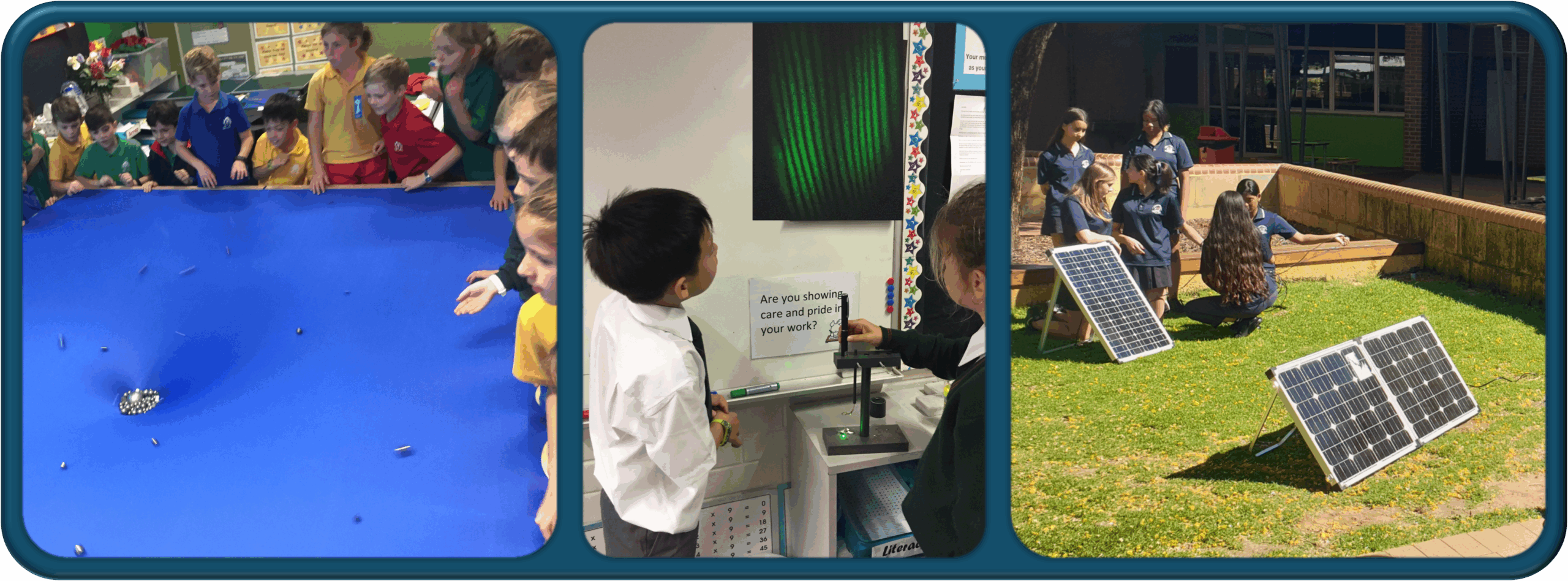
This 8-week unit for primary level educators will cover (a) our modern understanding of atoms, heat, states of matter, and the forces that hold them together; (b) the fact that light is made up of photons and the nature of the electromagnetic spectrum; (c) an introduction to the quantum nature of light and matter; (d) an introduction to the concept of spacetime and that gravity is caused by warped spacetime; and (e) the basic science of our climate and the key drivers of
climate change. In addition, mathematical concepts, which form the backbone of these scientific principles, will be introduced in an accessible manner. This unit will cover Year 3 – 6 curriculum topics. Additional extension material will be provided to further explore the in-depth understanding of gravity, spacetime, and Einstein’s relativity.
This Unit is eligible for the DEED-supported scholarships for WA-based educators.
Secondary Educators
In this introductory 8-week unit for secondary educators, participants will develop an in-depth understanding of: (a) our modern understanding of atoms, heat, states of matter, and the forces that hold them together; (b) the fact that light is made up of photons and the nature of the electromagnetic spectrum; (c) an introduction to the quantum nature of light and matter; (d) the nature of gravity and spacetime and how it fits into Einstein’s concepts of special and general relativity; (e) the basic science of our climate and the key drivers of climate change; and (f) the concept of energy, including Einstein’s famous E = mc² equation, the unifying concept of binding energy, and the concepts behind methods of renewable energy production. This unit will cover the foundational concepts related to a modernised primary curriculum alongside more advanced Year 7 & 8 curriculum topics. Additional extension material will be provided to introduce the mathematical foundations which underpin modern physical sciences.
This Unit is eligible for the DEED-supported scholarships for WA-based educators.
This 8-week unit synthesises and extends everything that is covered in PHYSM412 to cover a modernised Year 9 & 10 physical sciences curriculum. Participants will develop an in-depth understanding of the ideas behind quantum mechanics, including key concepts such as interference, phasors, quantum uncertainty, spin, and the particles of the standard model as well as electromagnetism and the electromagnetic spectrum of photons. Participants then learn about the physical mechanisms which are fundamental to the Earth’s climate, the history of the Earth’s climate and how planets form and evolve in the universe. They will then learn about how this relates to our understanding of the evolution of the universe, from the first instants of the Big Bang and the initial formation of the constituents of matter, all the way to the ongoing expansion of the universe due to dark energy. Additional extension material will be provided to explore real world applications of modern physics such as quantum technology, modern telescopes, gravitational wave detectors, and nuclear power and medicine, suitable for inclusion at the Year 11 & 12 level.
What’s right for me?
The full set of concepts which are included in Einstein-First’s primary curriculum for Years 3-6 are included in the primary unit and this should be sufficient for most classroom primary teachers, primary science specialists and other primary-level educators/science communicators. However, if you enjoy the course and would like to delve deeper into the concepts for a broader understanding of modern science, what your students will encounter in highschool, and what future careers in STEM may look like, you can continue into Unit II of the secondary course, although you will need to catch up on three weeks of free additional content covering Years 7 & 8 to align with the content covered in Unit I of the secondary course.
The key concepts for the lower secondary curriculum up to Year 8 are covered in Units I of the secondary course. This Unit introduces all of the concepts covered in Einstein-First’s primary curriculum as a lead-in to the Year 7 and 8 topics at a slightly accelerated pace.
While Unit II addresses topics more suitable for upper secondary classes (9/10 with extensions for 11/12), you are still sure to benefit from the additional broadening provided to your overall understanding of modern science if you choose to undertake these units as a lower secondary school teacher, making this an excellent opportunity for you to develop a deep understanding of both lower secondary science topics and the broader range of topics which your students will encounter as they progress onto upper secondary school and university.
Unit I of the secondary course provides an excellent grounding for all of the topics to be taught at the secondary school level, including at upper secondary levels, so if you are only able to commit to this units, you will certainly still be well served by the content covered in the first unit.
However, we strongly recommend that upper secondary teachers and science specialists complete the full course including Unit II as it addresses curriculum topics in Years 9, 10, and beyond, and these will best prepare you to teach modern science topics at all levels of schooling and provide you with the broader context of how what you’re teaching relates to the real-world science careers that your students will be pursuing.
We welcome all kinds of educators, including tutors, relief teachers, home schoolers, pre-service teachers, and other science communicators in general.
All practising or in-training WA-based educators/science communicators are eligible for DEED-supported scholarship positions.
We encourage you to consider the year levels you will be addressing in your teaching or science communication and follow the appropriate recommendations for teachers of those year levels provided above.
*Note: For pre-service teachers, you will need to check with your current educational provider to determine if micro-credential units can be counted towards your current program.
Eligibility
For general participants, there are no eligibility requirements to participate in these micro-credentials, and educators with no formal background in STEM are encouraged to participate.
The secondary course will cover the primary topics at an accelerated pace, so some background in STEM is recommended for educators participating in the secondary units, otherwise you may prefer to start with the primary unit.
To be eligible for a WA DEED-supported partial scholarship, you must be an educator or science communicator operating in Western Australia or otherwise be studying education or science communication in Western Australia.
Cost
The course is offered at the following subsidised rates:
- Cost for individual units: $600 AUD incl. GST for each unit
- DEED scholarship-supported cost (first Unit, WA educators): $120 AUD incl. GST
Ask your principal to support you in this invaluable professional development that will inspire you to make your teaching more fun and engaging for your students
Register
Enrolments will open soon for the February 2027 intake. Please submit you EoI here and you will be contacted with instructions on how to enrol as soon as they open.
Assessment
Weekly assessment will consist of a combination of multiple-choice concept quizzes and short answer tutorial questions which should take a total of 15-30 minutes per week. At the end of each unit, 1 week will be set aside for assessment. This will variously involve short written reports or short presentations on topics related to Einsteinian science and your teaching practice.
On successfully completing the course (or unit), you will be awarded with a Certificate of Completion.
Assigned Texts
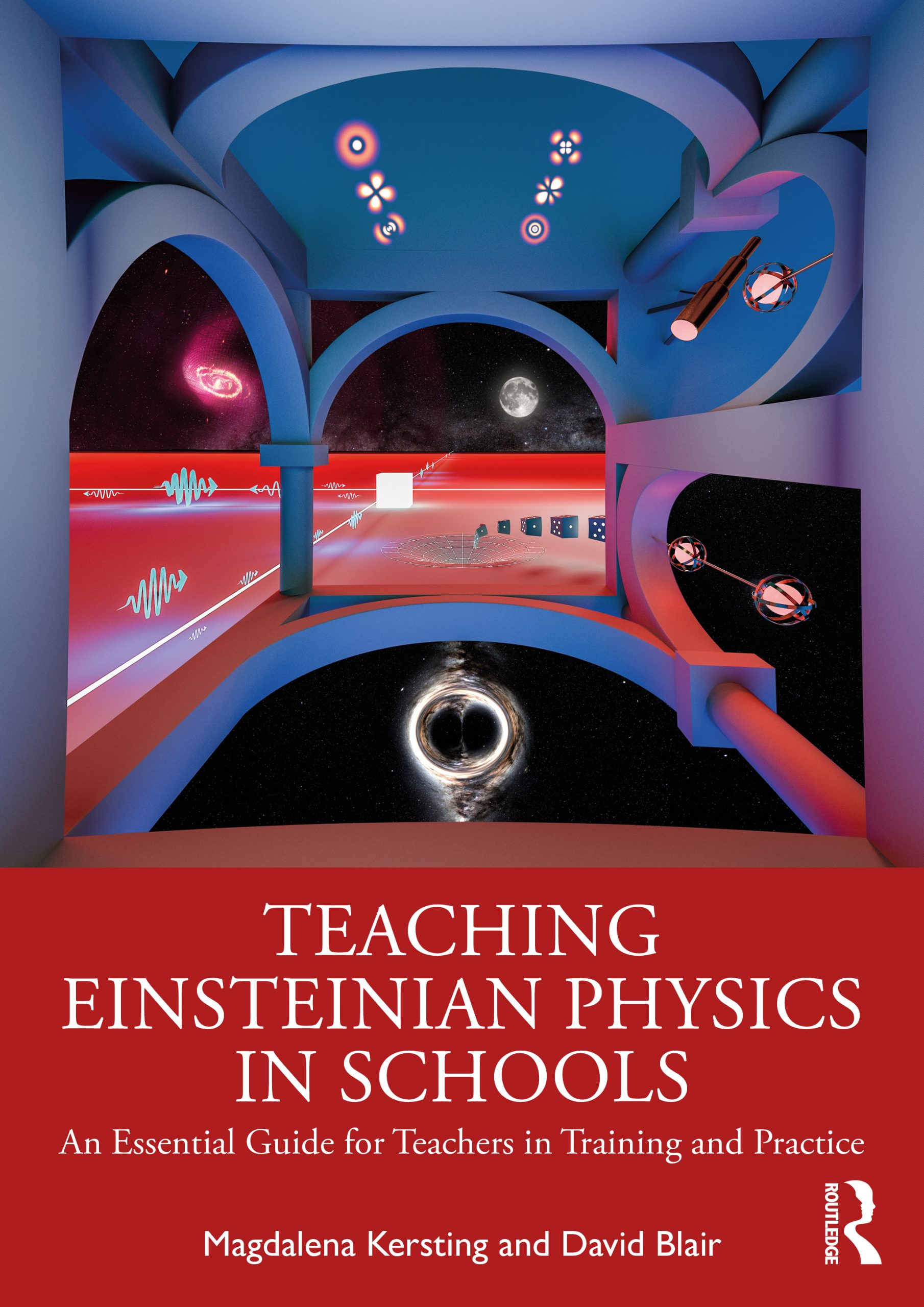
The course will frequently refer to our Teaching Einsteinian Physics in Schools book. While some excerpts will be provided, you may also like to purchase your own copy as a complete reference if you have the means to do so.
In addition to the textbook, readings will be assigned for each of our curriculum modules, as we cover the relevant topics in the course. You may like to get ahead by reading through some of our modules under the Resources tab above.
Course Credit
Completion of each Unit will provide 3 UWA credit points which can be counted towards a Bachelor of Science with a Physics Major at UWA. These course credits may also be recognised for credit towards the completion of degrees at other institutions, at their discretion.
Testimonials
Here’s what previous participants had to say
The Einstein-First Microcredential Course is a one-of-a-kind opportunity to learn how to teach cutting-edge science concepts in the science classroom. I went into the online class as an overseas student and the Einstein-First team went out of their way to accommodate me. Though I already knew quite a bit of the science, I was surprised at how much I learned in this course. The professors gave me new perspectives on subject material I already teach, and helped me realize there is a way to teach the Einsteinian concepts in the primary and secondary classroom settings. Even after the course, Einstein-First team members are supporting my efforts to implement their material in classrooms in the USA.
– Andy Crocker, M.A.T.
I have been teaching as a science specialist for a while now and was hoping to increase my scientific knowledge of modern science phenomenon as well as bolster my hands on program with new experiments that give kids deeper understanding. Along comes Einstein First with a curriculum that is exciting and cutting edge, delivered in a way that is not only engaging for students but puts them ahead for high school and beyond. This course gave me the ability to discuss modern science in a way that is relevant and exciting. The connection to the learning students see at a high school level helped me to better prepare my future scientists for life beyond primary school and equip them with a knowledge of the world that continues to fascinate us all.
– Chris Lambe, Level 3 Science Specialist